SEO SUITE & AUTOMATION · SOURCE-VERIFIED REVIEW
Search Atlas (OTTO SEO) Review: Is It Worth It in 2026?
Search Atlas goes beyond reporting what is wrong: OTTO can deploy supported fixes, while research, content and monitoring sit alongside it. That execution-first approach can help a busy team—but only if the changes are appropriate, the credit budget fits and the delivery layer is understood. Here is the current offer, the real trade-offs and how to evaluate automation without handing over your website blindly.

Lead SEO & AI Specialist · 13+ years in SEO
Published & fact-checked November 21, 2026 · 22 min read
In this review
The short answer: shortlist it for supervised execution, not a promise of effortless rankings
Search Atlas is worth evaluating when the bottleneck is turning SEO findings into reviewed, deployed work. OTTO's implementation layer, research and content tools can reduce handoffs. It is less compelling if you only need occasional own-site reports, have no reviewer for automated changes or cannot verify how your website receives and retains those changes.
- Best fit
- Active SEO teams, local businesses and agencies with a controlled implementation process.
- Entry configuration
- $99/month; one OTTO site; 50,000 UC; limited AI visibility. [1]
- Standout idea
- Research → approve a fix → deploy → verify → monitor.
- Main buying risk
- Confusing user seats, site slots, shared credits and integration-dependent output.
Evidence note: This is a public-documentation evaluation, not a paid-account hands-on benchmark. We have not tested deployment reliability, database accuracy, writing quality, support or ROI. Screenshots show vendor illustrations; recommendations are editorial judgments, with no invented testing hours or numeric review rating.
An important correction to older summaries: current Deep Freeze help says cancellation does not automatically erase deployed OTTO fixes while the required Pixel remains installed. That is continuity through an external layer, not permanent ownership of changes in your CMS. Confirm the purchased integration and exit behavior. [3]
This review is in our AI SEO tools category. Traditional organic-search execution is the primary focus; AI visibility is assessed as a separately measured capability.
What is Search Atlas, and how does OTTO SEO fit inside it?
Search Atlas is the web-based platform combining research, audits, content, monitoring and execution. OTTO SEO is the connected-site automation layer. Atlas Agent and Content Genius add agent and editorial workflows. Paying for the platform is not the same as buying unlimited automated domains or unlimited content output. [1] [2] [6]
The key capacity distinction is between a human team seat, a general project and an OTTO site slot. Help sometimes calls OTTO slots “seats,” but they refer to an active managed website rather than a person logging in. Public pricing currently lists one, two, four and ten OTTO sites across the tiers. Several help figures differ, so verify actual entitlements before onboarding clients. [1] [7] [8]
Research estimates, diagnostic grades, deployed output and measured performance are also different kinds of evidence. The platform can connect them operationally without making them interchangeable. A competitor traffic estimate is not that competitor's analytics; a deployed schema change is not a rich result; an AI mention is not a qualified lead.
Search Atlas SEO features: what they help you do and where judgment still matters
1. OTTO technical and on-page automation: make a supported change, then inspect it
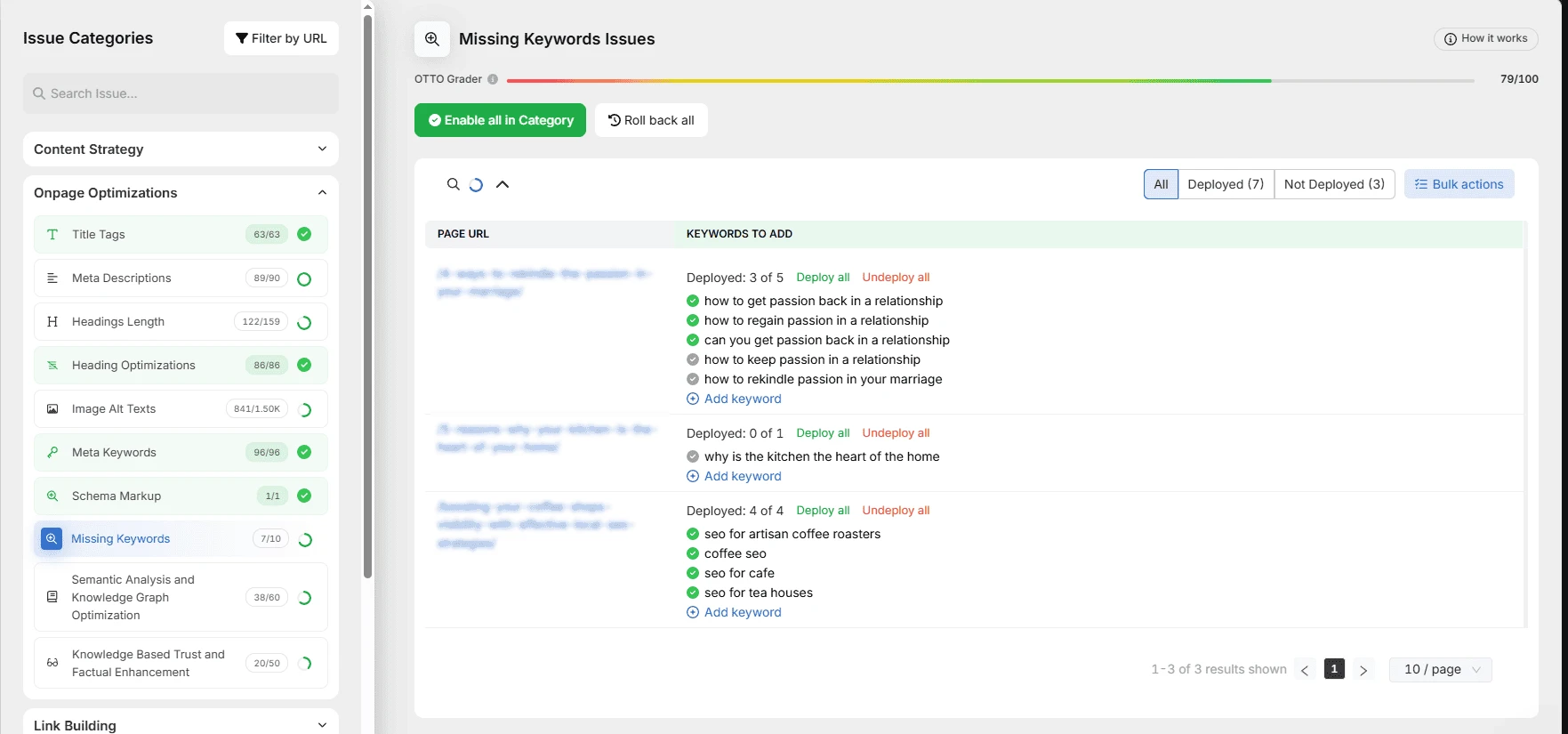
OTTO's public scope includes titles, descriptions, headings, internal links, image alt text, canonical and structured-data work. The interface presents issue categories and deployment controls. Marketing describes autopilot plus optional approval mode; help distinguishes preview and live changes. Start with approval, not blanket acceptance. [2] [3] [4]
A useful task is fixing genuinely missing titles on a small product template after validating product facts and output. A bad task is rewriting every heading to satisfy a length warning regardless of user needs. Canonicals, redirects and noindex choices require especially careful review because the “error” may be intentional. Check representative pages before expanding an automated rule.
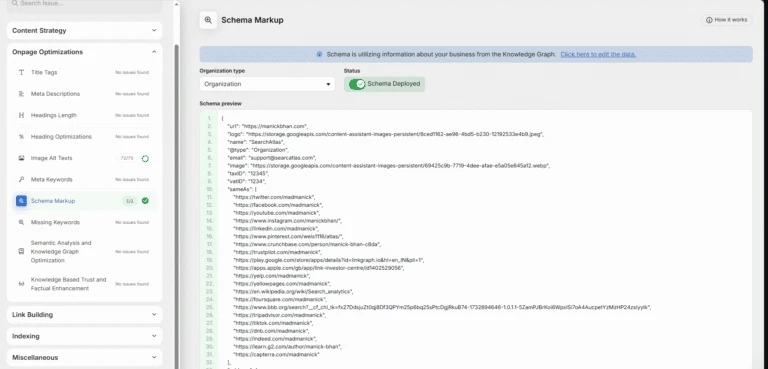
Do not assume schema presence guarantees eligibility or that duplicate plugin and OTTO output are harmless. Inspect the actual rendered and delivered HTML, validate a sample in Google's tools and ensure the declared entities match the page. A site grader is a triage aid, not Google's quality assessment.
2. Site Explorer: competitor, page and backlink research
Site Explorer accepts a domain, subdomain, subfolder or page and reports available organic/paid keywords, traffic estimates, backlinks, referring domains, competitors and supported AI-related signals. Its proprietary metrics include Domain Power, Topical Dominance and SEO Pillars. [5]
Start with several actual search competitors in the country that matters. Inspect a successful page's intent, coverage and evidence, then decide what your site can genuinely contribute. Test known keywords and backlinks in your niche before trusting claims about universal research breadth. We have not independently compared Search Atlas's index coverage or freshness with Semrush or Ahrefs.
Backlink and spam-probability signals are clues for investigation, not Google's verdict. Inspect linking pages, relevance and editorial context. Do not buy links or disavow useful references merely because a metric or automated suggestion recommends it.
3. Content Genius: research, brief, draft and publish preparation
Content Genius describes live-SERP research, topical maps, briefs, drafts, visuals, schema and publishing preparation from a keyword or URL. The current pricing page includes Content Genius and an AI content suite on Starter, with higher execution budgets on larger plans. [1] [6]
The valuable output is a reviewable editorial handoff: reader question, intended format, primary-source pack, original examples and a conversion step. Verify prices, technical claims, citations and image rights; do not allow fluent AI prose to manufacture first-hand experience. An automatically created article is not automatically expert, original or competitive.
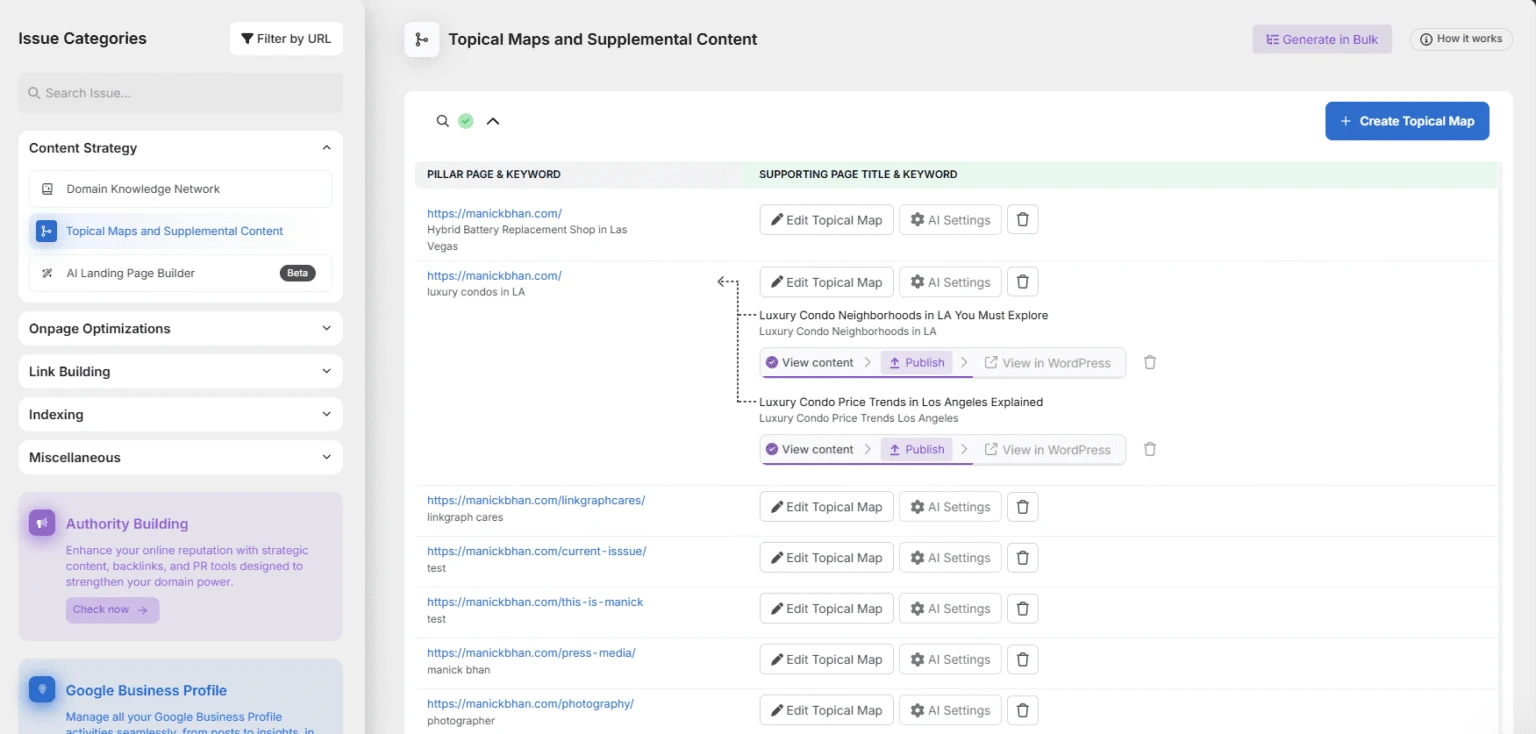
A topic cluster is a hypothesis, not an obligation to create dozens of overlapping pages. Merge variations that answer the same need, add useful internal links and commission the subjects your team can support with evidence. A high content score or vendor's speed claim does not establish search growth.
4. Rank tracking and site audits: capacity is not unlimited collection
Pricing lists tracked-keyword and audit-page capacities separately from Universal Credits. One rank refresh costs five UC. A campaign that fits under the keyword ceiling may still exceed the shared execution budget when refreshed frequently, especially alongside content and audits. Verify frequency, markets, devices and whether variations consume separate capacity. [1]
Keep branded discovery separate from commercial non-branded queries. Track the intended landing page, not only average position, and check Search Console clicks and conversion outcomes. For audits, inspect representative templates and confirm the actual cadence/per-run limits; the advertised page capacity does not define every accounting rule.
5. Local SEO, off-page work and Hyperdrive: keep actions accountable
OTTO markets local profile tasks, citations, PR and automated off-page activities. Current pricing lists Google Business Profile capacities of three, ten, 25 and 100, and separate Hyperdrive allowances. Help ties HDC to Cloud Stacks, press releases, citations and syndicated backlinks. [1] [2] [7]
Check names, addresses, opening hours and brand claims before publishing profile changes. For PR, require factual evidence and legitimate editorial relevance. Automated link generation or syndication is not a safe guarantee of authority; assess policy risk and quality instead of treating volume as success. Disclose paid placement where appropriate and review destinations before any batch action.
6. CMS connections, white-label reporting and agency delivery
Pricing advertises publishing to WordPress, Shopify, Webflow and custom stacks. OTTO marketing also names Cloudflare and code-pipeline delivery. Pro and Agency include white-label delivery; Agency adds client portals and portfolio operations. Those claims do not establish that every action uses the same integration or is written to native CMS fields. [1] [2] [4]
Test one staging page for metadata, headings, links, images, caching and mobile rendering. Give each client a defined project and access boundary, and keep original credentials out of shared reports. A branded dashboard should explain changes and first-party outcomes, not merely repeat vendor scores or estimated hours saved.
How OTTO deploys changes—and what Deep Freeze actually preserves
Rendered output is not necessarily a native CMS edit
Deploy All help describes approved fixes delivered through the OTTO Pixel with dynamic client-side rendering. A separate integration article says the WordPress plugin can apply output at the server/plugin level while CMS database and Yoast/Rank Math settings stay untouched. Current marketing adds Cloudflare, CMS and code-pipeline delivery. These descriptions should not be collapsed into “every change is JavaScript” or “every fix is permanently coded.” [2] [3] [4]
Verify your actual path: compare original response HTML, rendered DOM, CMS fields and cached output. Confirm logged-in vs. logged-out behavior and conflicts with existing plugins. Ask which action is a content publication, a plugin transformation or a Pixel-served override. We did not deploy OTTO to a live site, so this review cannot establish compatibility with your stack.
Approval, preview and rollback are different states
Help says preview changes are visible only in your browser session; deployed changes become live for visitors. Individual and bulk reversal are described, while frozen projects block editing and rollback until unfrozen. Keep a change log and baseline screenshots; test a rollback on one low-risk page before enabling a broad batch. [3] [4]
Approval mode is useful only if someone actually reviews. Assign a business owner for copy/facts and a technical owner for canonicals, schema and integration behavior. Avoid blanket changes on legal, regulated, checkout or high-value landing pages. A reversible mistake can still harm users or search visibility while live.
Cancellation does not automatically mean the fixes vanish
Current Deep Freeze help says that 24 hours after an account becomes unsubscribed, OTTO projects automatically enter read-only freeze with autopilot off. Existing deployed fixes continue while the Pixel remains installed; new crawling and changes stop. Removing the Pixel, disengaging or deleting the project stops the served fixes. Deep Freeze is listed as free on current plans, with account-specific verification advised. [3]
This is a meaningful continuity feature, but not an export of the changes into your CMS or a contractual guarantee of permanent hosted service. Before exit, inventory deployed fixes, export the data you need, decide what to recreate natively and test the transition. Do not remove the integration first and then discover which business-critical pages depended on it.
The integration help includes dated regression notes, including a WordPress CSS warning referencing May 24, 2026. That historical text does not prove the issue remains open in November. Ask about the current version, inspect its release notes and test staging; we do not present an old help entry as a confirmed current product failure. [4]
AI visibility and GEO: measure answers separately from automated SEO work
Starter now includes limited AI visibility: one project, one provider and 500 credits. Growth names ChatGPT, Gemini and Google AI Mode with 3,500 credits; Pro adds Copilot, Perplexity and Claude with 20,000. Agency lists 50,000 credits and broader project capacity. A platform logo does not establish every engine is included on your tier. [1]
Define a stable sample of buyer questions, brands, countries and languages, then inspect the captured answers. Keep brand mentions, linked citations, sentiment and observable referrals separate. Confirm what consumes an AI visibility credit, how it interacts with UC, collection cadence, answer retention and exactly which consumer surface or API is represented. Published credits are not a verified prompt-per-day entitlement.
Use findings to improve factual coverage, accessible structure and useful comparison information. OTTO can help execute supported changes, but a GEO-related recommendation is not proof that an answer engine retrieves or cites the page. Avoid adding unsupported claims or keyword stuffing simply because a model suggests it.
For measurement foundations, see how to choose brand-tracking prompts, LLM citation analytics and AI visibility vs. Google rankings. Compare specialist platforms in our AI visibility category.
Indexing caution: marketing says “indexed instantly” and references indexing workflows. Submission, notification or a deployed change cannot force Google to index or rank a URL. IndexNow support by a participating engine should not be described as a Google guarantee. Verify eligibility, canonical selection and indexing with first-party tools rather than promising outcomes based on a feature name. [2]
How to read scores, deployment counts and research estimates
| Signal | Useful question | Does not prove |
|---|---|---|
| Domain Power / SEO Pillars | Which proprietary dimensions deserve investigation? | A Google quality score or guaranteed rankings. |
| Topical Dominance / content score | Which subject coverage may need review? | Verified expertise, originality or required page count. |
| Estimated traffic / keyword data | What does the vendor observe about a competitor? | That competitor's measured visits or conversions. |
| Deployed fixes / flawless pages | What did the automation layer apply or classify? | Correctness, indexation or incremental revenue. |
| Hours saved | What modeled work might be avoided? | Our measured time savings or complete implementation cost. |
| AI mentions / sentiment / citations | How does the defined answer sample represent the brand? | All AI demand or a qualified website lead. |
OTTO's public time calculator assigns minutes per issue type; a page with several fixes counts several times. Treat that as a scenario model, not observed analyst time. Review, testing, implementation conflicts and maintenance can offset apparent savings. We do not repeat the vendor's “99% manual work” claim as a verified result. [2]
Report a fixed page/query segment, deployment dates, observed changes and first-party clicks/conversions. A rising grade with no useful change is not a successful SEO program. For client reports, explain what was shipped, why it mattered, what was verified and what remains uncertain.
Search Atlas pricing in November 2026: compare budgets, sites and actual access
The public page currently lists monthly Starter $99, Growth $199, Pro $399 and Agency from $999. It does not establish the older $79/$159/$319 annual equivalents as current purchase prices, so we do not reuse them. Annual services are mentioned, but obtain a current annual quote, total commitment and order-specific terms rather than inventing a discount. [1]
| Plan | Monthly price | Headline capacity |
|---|---|---|
| Starter | $99/mo | 1 OTTO sites; 50,000 UC/month; 500 AI visibility credits; confirm conflicting limits |
| Growth | $199/mo | 2 OTTO sites; 120,000 UC/month; 3,500 AI visibility credits; confirm conflicting limits |
| Pro | $399/mo | 4 OTTO sites; 400,000 UC/month; 20,000 AI visibility credits; confirm conflicting limits |
| Agency | From $999/mo | 10 OTTO sites; 1,000,000+ UC/month; 50,000 AI visibility credits; confirm conflicting limits |
| Allowance | Starter | Growth | Pro | Agency |
|---|---|---|---|---|
| Team seats | 1 | 3 | 5 on card / 4 in comparison; confirm | 10 |
| Core projects / OTTO sites | 1 / 1 | 2 / 2 | 4 / 4 | 10 / 10 |
| Tracked keyword capacity | 2,000 | 3,500 | 6,000 | 50,000 |
| Audit-page capacity | 50,000 | 100,000 | 10,000,000 | Unlimited advertised; confirm scope |
| AI visibility projects | 1 | 2 | 4 | Unlimited advertised; confirm scope |
| AI visibility credits | 500 | 3,500 | 20,000 | 50,000 |
| AI provider scope | 1 provider; confirm selection | ChatGPT, Gemini, Google AI Mode | Growth + Copilot, Perplexity, Claude | 6 named platforms as on Pro |
| Google Business Profiles | 3 | 10 | 25 | 100 |
| Separate HDC allowance | 0 | 15 | 30 | 100 |
Document conflicts: confirm before buying a client configuration
Pro lists five human seats on its card but four in the comparison table. Agency promotes unlimited keyword tracking while its numeric table lists 50,000. Other help pages give Growth ten OTTO sites, or call three Growth/five Pro slots “seats,” whereas current pricing lists two/four OTTO sites and three/five human seats. We use the current pricing's site counts, disclose the conflicts and recommend written confirmation—not whichever number looks most generous. [1] [7] [8]
Audit-page capacity, AI projects and core projects are also separate. Agency's unlimited AI-project language does not automatically mean unlimited OTTO domains or unlimited answers. Verify per-run vs. monthly audit accounting, location/provider multiplication, history and export limits against your billing record.
Universal Credits: a shared execution budget, not all the headline maxima at once
Pricing says actions across audits, content, tracking, visibility and publishing draw from UC. Its article/edit/rank-check combinations are examples, not independent unlimited allowances. Monthly plan UC are used first, then purchased UC; purchased credits never expire. Top-ups cost $1 per 1,000 UC. HDC remain separate at $1 per credit. Confirm how additional AI counters and legacy AI Gen Points map to your account. [1] [7]
Worked example: 100 keywords refreshed daily for 30 days create 3,000 refreshes. At 5 UC each, that uses 15,000 UC before other jobs. Refreshing all 2,000 Starter-capacity keywords daily would use 300,000 UC—far above its 50,000 included pool. The 250,000-UC difference is $250 at the published top-up rate, before content, audits, taxes or other limits. This is transparent workload arithmetic, not a quote or a claim every schedule is available.
Size a realistic month: expected refresh frequency, content jobs, audit cadence, publishing and visibility work. Record consumption during evaluation. A plan with enough site slots may still require top-ups; buying UC does not necessarily unlock a provider, team feature or white-label entitlement.
Extra OTTO sites and legacy accounts
Billing help advertises per-site add-ons at $99 for one, $85 for two–three, $69 for four–nine and $59 for ten–24, with custom pricing above that. It also uses older 500 AI Gen Points and 7.5 HDC per-site language. Treat these as documented add-on guidance requiring a quote, not a guarantee that new Universal Credit plans inherit the same pools or discount logic. Gold/legacy contracts may differ. [7]
Trial, cancellation and annual commitment
The pricing page advertises a seven-day trial plus one-to-one onboarding. Help says OTTO is not enabled on free trials by default. Confirm production deployment access, card requirements, conversion date, quota limits and renewal charges before connecting your site. A free trial of research does not prove the paid automation works on your stack. [1] [8]
Terms authorize recurring payments and describe cancellation through a representative with possible immediate access restriction. General payments are final; annual language says a 50% refund may be granted if requested within 72 hours and a 10% quota-usage condition is met, without fully defining that condition. Confirm checkout-specific rights and evidence requirements. Do not budget on an unconditional money-back promise. [9]
Explore Search Atlas & current plansPros and limitations: our editorial assessment
Reasons to shortlist
- Research, content, diagnostics and execution connect in one workflow.
- Approval/preview controls support supervised automation.
- Current Starter includes one OTTO site and limited AI visibility.
- Shared execution budgets let teams prioritize different jobs.
- Pro/Agency include white-label delivery.
- Deep Freeze provides documented cancellation continuity while the integration remains.
- Onboarding and a trial support an initial fit check.
Reasons to hesitate
- Site slots, human seats and multiple credit counters can confuse purchasing.
- Current pricing and help articles conflict on several limits.
- Integration-dependent output needs compatibility and exit planning.
- Full-capacity frequent rank checks can exceed included UC.
- Autopilot still requires factual and technical oversight.
- Off-page automation needs relevance and policy review.
- Trial deployment access and refund conditions require clarification.
These are product-scope and buying trade-offs, not claimed personal outages or inferior support. We have not benchmarked database coverage, deployment success, writing quality or time savings, and do not reuse review-site ratings as our own.
A practical evaluation: prove a safe change before scaling automation
Illustrative workflow—not an AIToolRush case study. Consider a two-site business with a content editor and a developer. Growth's current two OTTO sites and three seats may fit, but credit use, provider access and actual trial deployment require separate checks. A week can establish operational fit, not durable organic revenue.
Days 1–2: confirm entitlements and establish a baseline
Verify the purchased sites, people, quotas, engines and renewal terms. Choose a few representative templates and record delivered HTML, rendered output, metadata, schema and first-party performance. Connect only necessary accounts with limited permissions. Determine which integration delivers which action.
Days 3–4: test research, a brief and one proposed fix
Compare a known keyword and competitor page with observed evidence. Give Content Genius a source pack and have an editor inspect the brief/draft. Preview a missing metadata fix on a low-risk page, verify facts and test for plugin or caching conflicts. Record credit consumption and failed-job behavior rather than guessing from headline pools.
Days 5–7: deploy narrowly, verify and test reversal
On an explicitly enabled setup, approve a small batch, then compare response HTML, rendered DOM, CMS fields and visitor states. Validate schema and relevant indexability signals. Test undeploying one change and confirm its original output returns. Set a small fixed AI question sample and inspect actual answers separately from scores.
Weeks 2–4: scale only the behavior that passed review
Expand a verified rule to an appropriate template, annotate releases and watch for regressions. Maintain a realistic UC budget and a named reviewer. Keep content, canonical and off-page decisions under appropriate oversight. Compare Google clicks and qualified leads in stable segments, allowing for seasonality and search-result changes.
Before a long commitment: rehearse the exit
Inventory all deployed overrides and native content publications, test exports and document what will remain in Deep Freeze. Decide which useful changes should become native CMS rules. Confirm access, frozen-edit restrictions and integration dependencies in writing. A successful pilot means the team can explain and reverse the change—not just show a higher grade.
Search Atlas vs. Semrush, Ahrefs, SE Ranking and specialist tools
Search Atlas vs. Semrush: execution-first vs. a familiar research and campaign loop
Search Atlas's differentiator is connected implementation. Semrush is a strong candidate for a research-led workflow combining keywords, competitor pages, backlinks, audits and rankings. Compare your niche coverage and the complete configuration rather than unsupported universal database claims. Our Semrush review explains current plans and tier limits.
Search Atlas vs. Ahrefs: test actual research coverage
Bring the same country, competitor pages and known links to both. Evaluate exportability, history, seats and what insights analysts can act on. OTTO deployment is a different job from link-index research. Read our Ahrefs SEO review; its Brand Radar review covers separate AI visibility access.
Search Atlas vs. SE Ranking: price a real operational month
Compare monitored sites, ranking frequency, human seats, audit accounting, reporting and AI access. Search Atlas's keyword capacity and UC refresh spend need to be sized together; SE Ranking's separate limits require their own review. Use the SE Ranking review rather than comparing two entry prices with different capacities.
Search Atlas vs. Screaming Frog: automation vs. independent technical investigation
A specialist crawler is useful for controlled extraction, rendering, migration and independent verification of what OTTO delivers. It does not supply the same content, off-page or managed execution workflow. Our Screaming Frog review explains licence limits and technical checks. Using a separate crawler to verify an automation layer can be a sensible complementary role.
Search Atlas vs. Surfer, Frase and Clearscope: compare the editor's actual job
If the bottleneck is briefs, writing review and content upkeep, test the same assignment in Surfer, Frase or Clearscope. A broader suite is only better value if its other jobs are used. Do not stack subscriptions just to obtain several different content scores.
For more choices, explore Semrush alternatives and our AI SEO tools shortlist. Dedicated Profound addresses a different primary answer-engine workflow rather than replacing every traditional SEO job.
Before buying: the Search Atlas and OTTO checklist
- Job: Is execution the real bottleneck, and who reviews changes?
- Coverage: Does research cover our actual market, competitor pages and known links?
- Sites vs. people: What are the confirmed OTTO domains, projects and human seats?
- Budget: Does our real refresh/content/audit schedule fit UC and separate counters?
- Integration: Are changes native publications, plugin output or Pixel overrides?
- Safety: Can we preview, narrow deployment and successfully roll back?
- AI: Which engines, locations, cadence and retained answers are included?
- Agency: Are white label, portals and project boundaries included in this offer?
- Off-page: Are destinations and claims appropriate, relevant and policy-compliant?
- Exit: What does Deep Freeze preserve and what must be recreated natively?
- Terms: Have we confirmed trial access, renewal, annual commitment and refund conditions?
Search Atlas and OTTO SEO: frequently asked questions
Sources, evidence and review methodology
This review was researched against official pricing, product and help pages on November 21, 2026. Product screenshots are public vendor illustrations, not our account or outcomes, and may show a previous interface. Features are cited inline; buying recommendations and workload arithmetic are our analysis.
We assessed technical/content workflow, implementation control, capacity transparency and exit conditions. We did not use a paid account, measure indexing success, independently audit the database, test support or establish ROI. No invented numerical review rating appears here. Conflicting help/pricing limits and dated regression notes are disclosed instead of treated as settled current facts. This date records real research, not automatic monthly re-verification.
- Current Search Atlas pricing
Monthly plans, UC pools, rank-refresh cost, AI visibility, OTTO sites, top-ups and conflicting seat/keyword limits.
- OTTO SEO product page
Technical and on-page automation, topical maps, local/off-page features, approval mode and official images.
- Deploy All and Deep Freeze
Pixel-delivered changes, automatic freeze 24 hours after unsubscribe, free continuity, read-only behavior and integration dependency.
- Front-end vs. back-end changes
Preview/live behavior, WordPress server/plugin delivery, untouched CMS fields and dated regression notes.
- Site Explorer
Domain/page competitor research, keywords, backlinks, Domain Power, topical and AI-related metrics.
- Content Genius
SERP research, briefs, drafts, topical maps, visuals, schema and publishing preparation.
- Plans, credits and billing help
Monthly resets, separate add-ons, legacy AI Gen Points/HDC terminology and conflicting site inclusions.
- OTTO slots and onboarding help
One active website per OTTO slot; trial access and site-slot figures differ from current pricing.
- Terms of Use
Automatic payments, cancellation, possible access restriction and limited discretionary annual-refund language.
Read our review methodology and affiliate disclosure. Found a product change? Send a correction.
The bottom line: buy controlled execution, not an autopilot promise
Search Atlas's strongest case is shortening the distance between a useful SEO finding and a verified live improvement. OTTO, research and content can work together, while AI visibility provides a separate observation layer. Its value depends on the actual tasks performed—not a high score, broad engine list or modeled hours saved.
Our recommendation: shortlist it for a supervised, implementation-focused SEO program. Confirm the real site/seat/credit configuration, verify your delivery path, test narrow deployment and rollback and prepare an exit plan. Deep Freeze improves continuity, but does not remove dependency on the serving layer. For occasional reports or a single research/editorial job, compare a narrower tool first.