ENTERPRISE AEO · SOURCE-VERIFIED REVIEW
Profound Review: Is This Enterprise AEO Platform Worth It in 2026?
Profound connects AI-answer visibility, prompt demand, citation intelligence and marketing agents. That is a compelling proposition—but buying a broad platform is not the same as building a successful AI-search program. Here is what it actually offers, what the current pricing leaves open, and how to decide whether it belongs in your stack.

Lead SEO & AI Specialist · 13+ years in SEO
Published & fact-checked November 21, 2026 · 18 min read
In this review
The short answer: powerful for an owned enterprise program
Profound is worth shortlisting if your team needs more than a brand-mention tracker: you want demand research, multi-engine monitoring, source-level diagnosis, website analytics and repeatable marketing workflows. It is a less obvious purchase if you only need an inexpensive weekly snapshot and have no capacity to act on the data.
- Best fit
- Enterprise brands and agencies with a dedicated AI-search owner.
- Current price
- Custom Enterprise quote; no public fixed entry price. [1]
- Standout combination
- Prompt demand + answer/citation intelligence + marketing agents.
- Main buying risk
- Paying for scope and credits your team cannot operationalize.
Evidence note: This is a public-documentation review, not a paid-account hands-on benchmark. We have not independently tested capture accuracy, onboarding speed or traffic lift. No invented performance percentages, customer interviews or numeric review score are used.
What is Profound—and what does AEO mean here?
Profound is a web-based marketing platform built around how brands appear in AI search. Its core products include Answer Engine Insights, Prompt Volumes, Agent Analytics and Agents; the current offer also includes AI Marketer, Projects, Context Manager and Profound Sheets. Think of it as a research-to-action layer for AI search rather than simply an alternative Google rank tracker. [1] [5]
AEO (answer engine optimization) aims to make a brand’s information useful and discoverable in AI-generated answers. GEO (generative engine optimization) overlaps heavily with that goal. Neither implies that a vendor can control an AI engine’s recommendations. A tool measures a defined sample, helps explain it, and supports changes you still need to validate.
The useful distinction is between being mentioned, having a source cited, and earning a business outcome. A brand can appear without a link. A publisher’s comparison can mention your product while receiving the citation. A citation can produce no visit. Profound’s breadth is interesting precisely because these are different questions, not one interchangeable “AI ranking.”
For the fundamentals, read what GEO means and our guide to AI search visibility vs. traditional SEO rankings.
Profound’s key features: what you can actually do
1. Answer Engine Insights: monitor answers, not just links
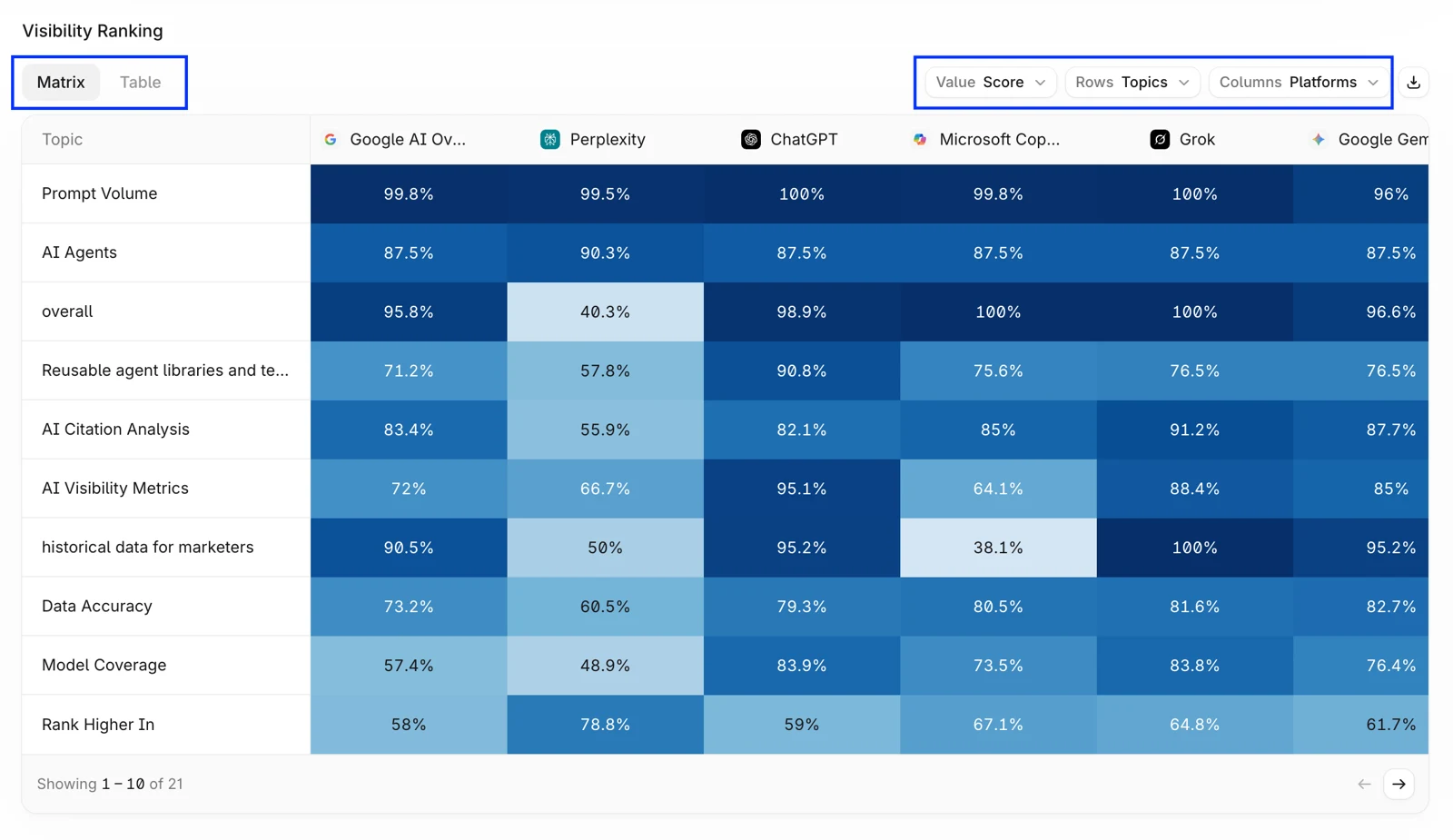
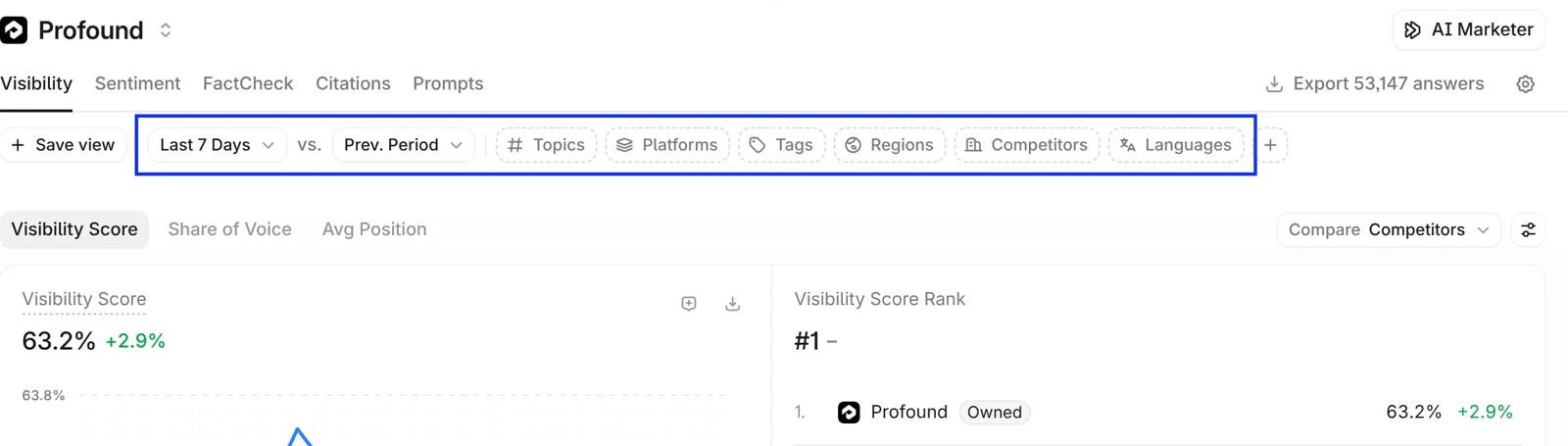
The documented interface separates Visibility, Sentiment, FactCheck, Citations and Prompts. You can filter by time window, topics, platforms, tags, regions, competitors and languages, save views, and compare results across dimensions. Enterprise advertises daily prompt tracking and capability for up to ten answer engines; confirm your purchased engine/region configuration rather than assuming all capabilities are included. [1] [2]
Why this matters: an executive chart might look stable while your highest-value category loses visibility in one market. A topic-by-platform heatmap gives the team a more actionable question: which segment changed, in which engine, and which captured answers explain it?
2. Citation intelligence: discover the sources behind the answer
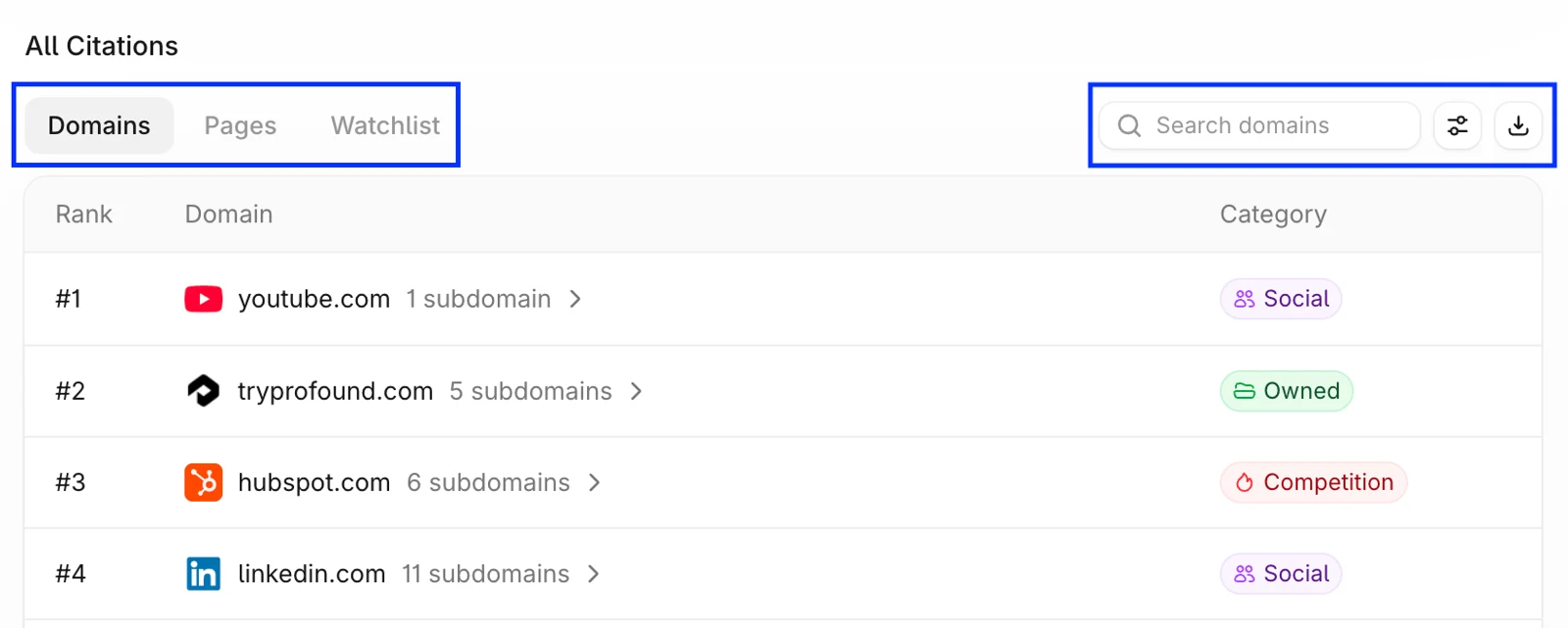
The Citations tab provides Citation Share and Citation Coverage, source categories, domain/page tables and a watchlist. The documentation also describes Citation Decay, Citation Ranking and Citation Relationships. Owned and competitor source categories can be configured, with other classifications assigned automatically and overridable in settings. [2]
How to use it: separate owned-page opportunities from third-party influence. If your documentation is missing from technical answers, improve the relevant accessible page. If a comparison publisher is repeatedly cited, consider a factual product update or legitimate editorial outreach. Do not assume buying a backlink will cause an AI recommendation.
3. Prompt Volumes: choose what is worth tracking
Prompt Volumes is different from the prompts you enter into a monitoring project. Profound says it licenses double opt-in consumer panel data, cleans and anonymizes it, and applies probabilistic modeling to correct demographic and geographic biases. Its FAQ lists ChatGPT, Gemini and Perplexity, with coverage varying by country, rolling weekly updates and less than two weeks of latency. These are vendor methodology statements, not our audit of the underlying panel. [3]
Added value: this can move a team beyond guessing which prompts buyers use. But “real prompts” does not mean a census of every conversation. Panel composition, region, platform coverage, grouping and modeling still shape the estimate. Use demand data to prioritize topics, then validate intent against sales questions, support tickets and customer research.
Keep a stable monitoring baseline alongside exploratory prompts. Constantly adding high-volume topics changes the sample and can move your overall visibility score even if the brand’s actual answers have not improved.
4. Agent Analytics: connect AI activity with your own website
Profound positions Agent Analytics as a way to monitor AI crawler activity and AI-sourced traffic/attribution. Its current pricing lists integrations including Cloudflare, AWS, Akamai, Fastly, Google Analytics, Google Cloud Platform, Netlify, Vercel and WordPress. The specific data available depends on the integration you deploy. [1] [5]
Do not conflate three signals: a crawler request shows a bot accessed a resource; a cited answer shows that a source appeared in a captured response; a referred session shows someone reached your site through an identifiable referral. None alone proves incremental revenue. Ask for bot classification, treatment of unknown user agents, referral rules and conversion configuration during the demo.
5. AI Marketer, Agents and Sheets: turn research into repeatable work
AI Marketer is positioned as a brand-aware teammate; Context Manager supplies brand knowledge, Projects organize collaboration, Agents build reusable workflows, and Sheets runs workflows across rows. These features can support repeatable research and content tasks, but AI activity has a separate credit budget. [1] [4]
A useful pilot is a citation-gap brief: collect a topic’s missing owned sources, compare the competing cited pages, propose a factual content brief, and require an editor to approve it. This is more defensible than automatically publishing dozens of generic “AEO-optimized” pages. Supply product facts, brand guidance and permitted sources; review claims, originality and usefulness before publication.
6. Enterprise reporting, exports and governance
The public Enterprise table lists CSV/JSON exports, API access, unlimited seats, SSO/SAML, SOC 2 compliance and dedicated support. It also describes all-time history. Treat these as a starting point for procurement: confirm historical coverage for each dataset, export granularity, API limits, retention, service terms and the current security report. “All time” should not be read as backfilled monitoring of prompts you have never tracked. [1]
How to read Profound’s metrics without fooling yourself
The interface explicitly separates visibility, share of voice, average position and citation metrics. That separation is a strength—but it only helps if your reporting keeps the denominators and sampling configuration visible. [2]
| Signal | Useful question | Do not infer |
|---|---|---|
| Visibility | How often does our brand appear in the monitored sample? | Market-wide awareness or guaranteed recommendation. |
| Share of voice | How does our presence compare with configured competitors? | A score comparable across vendors or competitor sets. |
| Average position | Where is the brand placed in answers containing ranked mentions? | A universal Google-style ranking for all users. |
| Citations | Which domains and URLs are cited in captured answers? | That every mention links to our website. |
| Sentiment / FactCheck | Which descriptions or claims need a closer review? | That automated classification is ground truth. |
| Prompt demand | Which questions appear in the modeled panel dataset? | Exact worldwide volume or complete user coverage. |
| AI referrals | Which identifiable visits and conversions reached our site? | All AI influence, including unclicked recommendations. |
A reporting habit worth adopting: attach the engine, region, date range, prompt set and response count to every chart. Review the raw answers behind spikes. Separate branded queries from non-branded buying queries, and keep “no answer” or absent AI Overview cases visible in the methodology. Changing your sample can look like performance improvement.
For source-level analysis, see LLM citation analytics explained.
Profound pricing in November 2026: custom, not $499/month
The current public price is Custom Enterprise. The official FAQ says Profound retired Starter and Growth plans for brands in September 2026; the associated $399 and $499 prices are no longer available for new subscriptions. Old reviews quoting those prices should not be used as a current purchasing baseline. No minimum contract value is published on the page we checked. [1]
The Enterprise offer uses custom tracked-prompt limits, languages, regions, Prompt Volumes searches and AI Marketer credit packages. Unlimited seats and domains are listed, but they do not make the overall contract unlimited. Obtain the actual configuration and usage rules in writing.
The second budget: agent and AI-work credits
Credit documentation identifies AI Marketer messages, Agent/Workflow runs (including tests and schedules), Sheets runs and Prompt Research Reports as consuming credits. Browsing Answer Engine Insights, Prompt Volumes and Agent Analytics data does not consume credits. Cost varies with the complexity and tools involved. Trial credits are mentioned in the documentation, but public trial availability and terms are not established by that mention. [4]
- Scope: request a quote for the same engines, regions, prompt count and history window you use to evaluate competitors.
- Usage: estimate how often each workflow runs and how Sheets row counts multiply it; include retries and test runs.
- Controls: choose whether excess use pauses or incurs overage charges, and identify who can schedule expensive workflows.
- People: budget for analysis, editorial review, outreach and technical implementation—not only the subscription.
Our take: the economically sensible question is not “How many dashboards do I get?” It is “Which recurring decisions or tasks will this change, and what is that worth?” A custom quote makes a scoped pilot particularly important.
Explore Profound & request a demoPros and limitations: our editorial assessment
Reasons to shortlist
- Combines demand research, visibility diagnosis and workflow execution rather than stopping at mentions.
- Detailed topic, engine, region and source views support specific decisions.
- Own-site analytics adds a different signal from answer monitoring.
- API, exports and enterprise governance can fit a broader reporting stack.
- Documented distinction between monitoring data and credit-consuming AI work.
Reasons to hesitate
- No transparent fixed entry price for new brand subscriptions.
- More breadth means more ownership, onboarding and implementation work.
- Prompt-demand coverage is not the same as answer-engine monitoring coverage.
- Panel modeling and stochastic AI answers require careful interpretation.
- Agents introduce variable consumption and an editorial review burden.
- We cannot establish capture accuracy or incremental lift from public documentation.
These judgments reflect the documented product structure, not a claim that we personally experienced bugs, poor support or a particular learning curve. We deliberately avoid unverified review counts, funding figures and customer-success percentages: they do not answer whether the product fits your workflow.
A practical 30-day Profound evaluation plan
Illustrative workflow—not an AIToolRush case study. Imagine a B2B software company that wants to appear for category comparisons and implementation questions. The following plan is a recommended evaluation design; none of the outcomes below are promised or reported test results.
Week 1: define the decision and build the baseline
Select one commercial topic cluster, a small fixed set of relevant competitors and your priority market. Gather questions from sales, support and customer interviews; use Prompt Volumes to enrich the set, not replace those inputs. Tag branded, non-branded, comparison and post-purchase intent separately. Record the engine/region configuration and preserve initial answers before making changes.
Week 2: map the citation gap
Find prompts where competitors appear but your brand does not. Inspect the corresponding domains and pages. Divide opportunities into owned content, factual third-party coverage and technical accessibility. For each, document an owner, the proposed change and the evidence it addresses. A long list of missed prompts without prioritization is not a strategy.
Week 3: make a small number of attributable changes
Improve a genuinely useful category page or product document with clear answers, substantiated comparisons, appropriate headings and visible facts. Correct outdated public product information through legitimate channels. Trial an Agent-generated research brief with human review. Keep a change log; avoid rewriting everything at once if you want to learn which intervention might matter.
Week 4: review stability and operational value
Compare the same prompt set and segment against the baseline, then read the changed answers. Look for repeated changes over several collection periods rather than one lucky response. Check identifiable AI referrals separately. Ask whether analysts found useful tasks faster, whether content changes were actually shipped, and whether agent consumption was predictable.
A reasonable early success criterion: your team can turn a documented citation gap into a reviewed action and measure the relevant segment afterward. Thirty days can test workflow fit; it is generally too short to establish durable, causal revenue impact.
Use our prompt-selection framework and AI search visibility playbook to prepare before the demo.
Profound vs. Nightwatch, AIclicks and Semrush
Compare the job you need done, not an unsupported “accuracy winner.” The same engine name does not guarantee the same collection method, prompt sample or geography. Our recommendations below are workflow distinctions; ask each vendor to demonstrate your real inputs.
Profound vs. Nightwatch: dedicated AEO vs. an SEO-first workflow
Shortlist Profound for a dedicated enterprise program spanning demand research, citations and marketing agents. Evaluate Nightwatch if your team wants conventional rank tracking and AI monitoring within the same SEO toolkit. In the demo, verify AI-specific location handling separately from classic search location coverage. Read the Nightwatch review.
Profound vs. AIclicks: enterprise breadth vs. a focused GEO tool
AIclicks is another candidate for teams interested in combining AI visibility and content output. Compare its current model selection, prompt allowances and content workflow with the Profound configuration you are quoted. Profound’s demand research and enterprise controls may matter more than a lower entry cost; a smaller team may not need that breadth. Read the AIclicks review.
Profound vs. Semrush: a separate platform vs. your existing suite
If you already rely on Semrush, test its current AI visibility offering before adding another platform. Profound is compelling when source analysis, demand research and marketing workflows justify a dedicated tool. Semrush can be the pragmatic route when consolidating conventional SEO and AI reporting is the priority. Compare the current package—not an old toolkit add-on price. Read the Semrush review.
Peec AI, Otterly.AI and other monitoring alternatives
Teams focused primarily on visibility reporting should also evaluate lighter platforms. Use a matched prompt set, confirm engine add-ons and exports, and calculate the full bill. Profound is not automatically the right buy because it has more modules. Our AI search visibility tools comparison covers the wider shortlist.
Questions to bring to a Profound demo
Ask the salesperson to work through your category, not only a polished example brand. A convincing demo should connect a specific answer to a specific source and a realistic next action.
- Collection: Which consumer interfaces or APIs are used for each engine? How are search modes, logged-in state, language and location handled?
- Sampling: How many executions per prompt and period? What happens to failed collections or absent AI Overviews?
- Evidence: Can we open raw answers, timestamps and exact cited URLs, and audit alias matching and sentiment classifications?
- Demand data: What is the panel coverage for our country and category? Which estimates are modeled, and how are prompts grouped?
- Historical access: Which dataset has backfill, and from when? What happens when prompts or competitor lists change?
- Website analytics: Which integration is required, what does it collect, and how are bot requests separated from human visits?
- Agents: Can we approve outputs before publication and restrict tools, knowledge sources and scheduling permissions?
- Economics: What are the included credits, expected workflow costs, overage rates, contract term and cancellation provisions?
- Governance: Can we review the security report, DPA, retention rules, AI subprocessors and treatment of uploaded brand material?
- Exit: Can we export answers, citations and time-series data in a usable format before the contract ends?
Decision rule: buy only when you can name the person who owns the program, the recurring decisions the data will change, and the work your team will deliver. Otherwise, begin with a narrower monitoring setup and revisit the enterprise platform later.
Profound review: frequently asked questions
Sources, evidence and editorial methodology
This review was researched against Profound’s official pricing, feature and documentation pages on November 21, 2026. Product facts are attributed inline; screenshots come from its public documentation and show vendor example data. Prices and contractual entitlements may change—your written quote takes precedence.
We assessed feature scope, metric interpretability, purchasing transparency and practical workflow fit. We did not access a paid Profound account or audit its panel, security controls or capture accuracy. Suggested workflows are illustrative, not customer case studies. This page intentionally omits a numerical rating and unverified ROI claims. The fact-check date records this research, not an automatic monthly re-verification.
- Profound pricing and plan FAQ
Current Enterprise offer, engine capabilities, daily tracking, seats and retirement of brand Starter/Growth plans.
- Interpret Answer Engine Insights
Current dashboard, filters, visibility, citations, FactCheck and official product screenshots.
- Prompt Volumes FAQ
Opt-in panels, modeling, platform coverage and data latency. These are the vendor’s methodology statements.
- Profound usage pricing: Credits
What consumes credits and how AI work is billed.
- Profound feature overview
Product positioning: Answer Engine Insights, Prompt Volumes, Agent Analytics and Agents.
See our review methodology and affiliate disclosure. Found a product change? Send a correction.
The bottom line: demo the workflow, not the promise
Profound’s strongest argument is the combination: identify demand, observe answers, investigate citations and turn findings into repeatable work. That can be valuable to an enterprise team that already has the people and processes to act. It is not proof of superior accuracy, a shortcut to citations or a guaranteed traffic channel.
Our recommendation: shortlist Profound for an owned, cross-functional AI-search program. Bring a real prompt cluster to the demo, request a scoped quote and validate raw evidence plus agent economics before committing. If your need is just affordable monitoring, compare simpler tools first.