SEO CONTENT OPTIMIZATION · SOURCE-VERIFIED REVIEW
Surfer Review: Is This SEO Content Platform Worth It in 2026?
Surfer turns competitor-informed content research into a working brief, live writing guidelines and a refresh queue. Its appeal is not a magical score: it is a shorter path from “this page needs work” to a useful, reviewed improvement. Here is how its content tools fit a real SEO program, what the current plans actually include, and when a broader suite is the better purchase.

Lead SEO & AI Specialist · 13+ years in SEO
Published & fact-checked November 21, 2026 · 22 min read
In this review
The short answer: a strong editorial workflow, not a complete SEO department
Surfer is worth shortlisting when your main SEO bottleneck is briefing, writing or improving content—and someone will implement its recommendations. Its strongest fit is an active editorial program with pages to create or refresh. It is less compelling when your biggest problems are crawling, backlinks, indexing, product positioning or a lack of original expertise.
- Best fit
- Content teams, specialist publishers, SEO-led businesses and agencies with a recurring editorial backlog.
- Entry content plan
- Discovery: $49/month on annual billing; 120 documents and 10 tracked pages. [1]
- Standout workflow
- Competition-informed guidelines → reviewed content → published refresh → first-party performance check.
- Main buying risk
- Confusing document allowances with generated articles, or buying Pro for capacity it does not add.
Evidence note: This is a public-documentation evaluation, not a paid-account hands-on benchmark. We have not independently measured ranking uplift, AI citation lift, support quality or time saved. No invented testing hours, customer ratings or numerical review score are used.
Scope: this review sits in our AI SEO tools category and focuses on content-led organic search. For prompt tracking, answer collection, mentions and citations, read the separate Surfer AI Search Analytics review.
What is Surfer—and what is it not?
Surfer is a web-based content platform built around Content Editor, Content Audit and Topical Map. It helps plan coverage, create or revise pages and identify where existing content may need attention. Its newer AI tracking capabilities add a measurement layer on eligible plans, but do not change the underlying need for useful content. [2] [3] [4]
Think of it as an editorial decision environment, not simply an AI writer. You can bring your own draft, import a published page or use writing assistance. Competition-based guidelines then expose potential gaps in terms, topics and structure. An editor must decide which gaps are meaningful and which suggestions would make the page worse.
It does not replace a full technical SEO investigation, broad backlink intelligence, business analytics or your editorial policy. Content Audit is about performance and refresh opportunities; it is not equivalent to a crawl diagnosing canonical chains, blocked templates or JavaScript rendering. Content ideas do not establish commercial demand on their own.
The purchasing distinction: Discovery and the content bundles include content tools; standalone AI Search Analytics is tracking-only. Standard and Pro both advertise 360 documents on the annual offer, but their feature and AI-monitoring scopes differ. Compare the specific job, not just the tier name. [1]
Surfer's SEO content features: where they create practical value
1. Content Editor: put the brief and the draft in one place
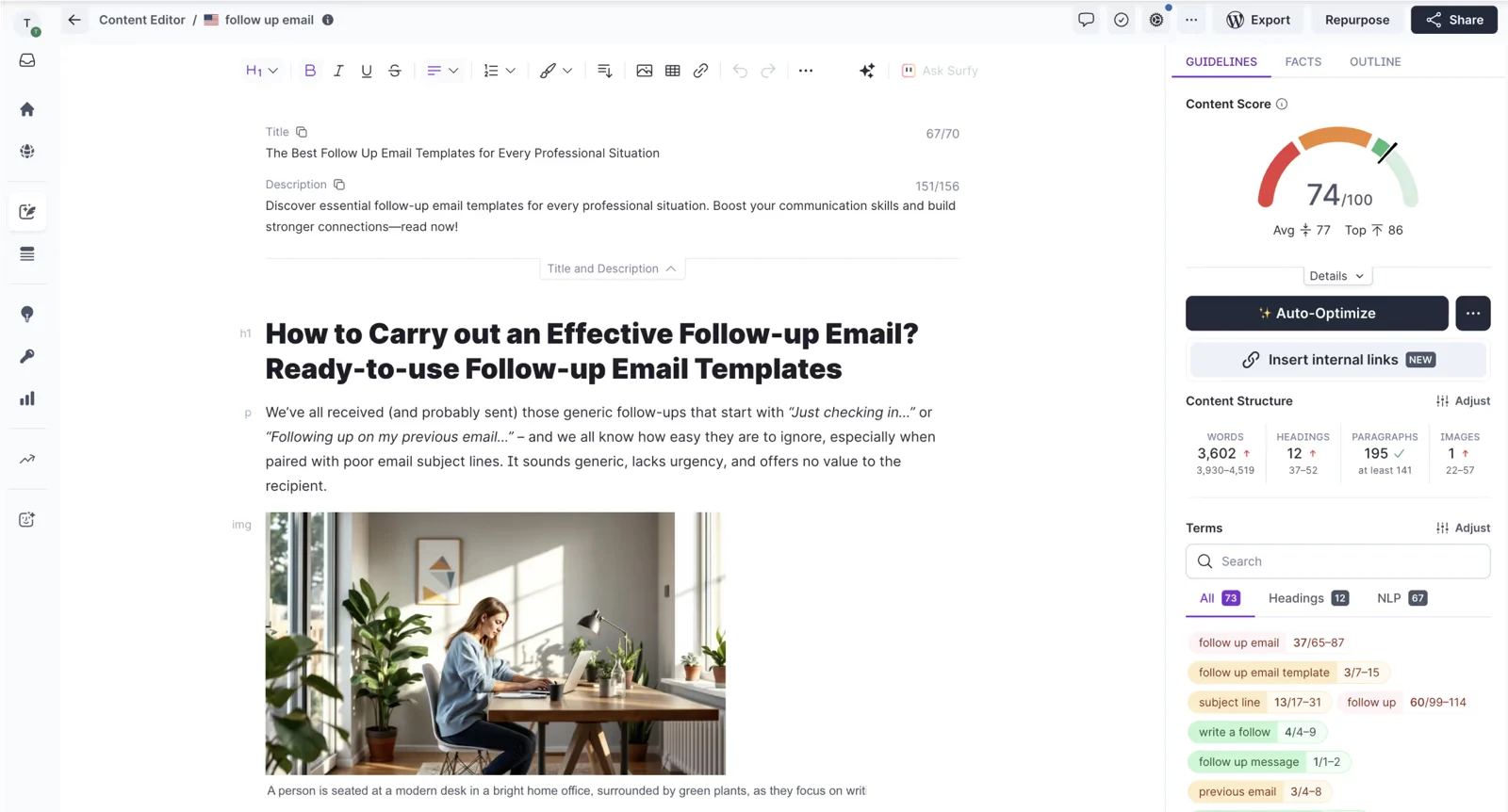
Content Editor offers real-time guidelines for structure, word count, relevant terms and images, alongside Content Score and an Outline Builder. It supports starting from scratch, pasting text or importing an existing URL. Surfer describes the guidance as competition-based, using NLP and machine learning; its advertised “500+ signals” is a vendor description, not an independently verified inventory of ranking factors. [2]
A useful brief: specify the audience, target query, intent, page format, questions to answer, sources to consult and the desired next step. Add your own product facts, expert observations and examples before handing the work to a writer. A suggested heading can help structure a section; it cannot supply the expertise that section requires.
Where people go wrong: they treat every suggested term or length range as mandatory. If relevant comparison pages average thousands of words, that does not prove your focused answer needs the same length. Inspect whether the analyzed pages genuinely match your query, market and format. A mismatched comparison set can produce confidently irrelevant advice.
2. Content Score and Topics: turn gaps into editorial questions
The live panel makes recommended coverage visible while you edit. Topics adds another lens for missing ideas and competitor coverage. The practical benefit is a common review language: writer and editor can discuss what is absent rather than exchanging vague instructions to “make this more SEO-friendly.” [2]
For a buying guide, a missing topic might reveal that readers need compatibility, setup costs or limitations. Resolve the underlying question with evidence rather than sprinkling its keywords through the page. Conversely, omit a recommended topic that belongs to another intent. Treat the score as a diagnostic conversation, not the editorial acceptance criterion.
3. Content Audit: prioritize refreshes instead of rewriting everything
Content Audit connects to Google Search Console and presents content performance, ranking changes and “Best Opportunities.” It is designed to help identify pages worth improving and provide weekly recommendations, then move the chosen page into Content Editor. [3]
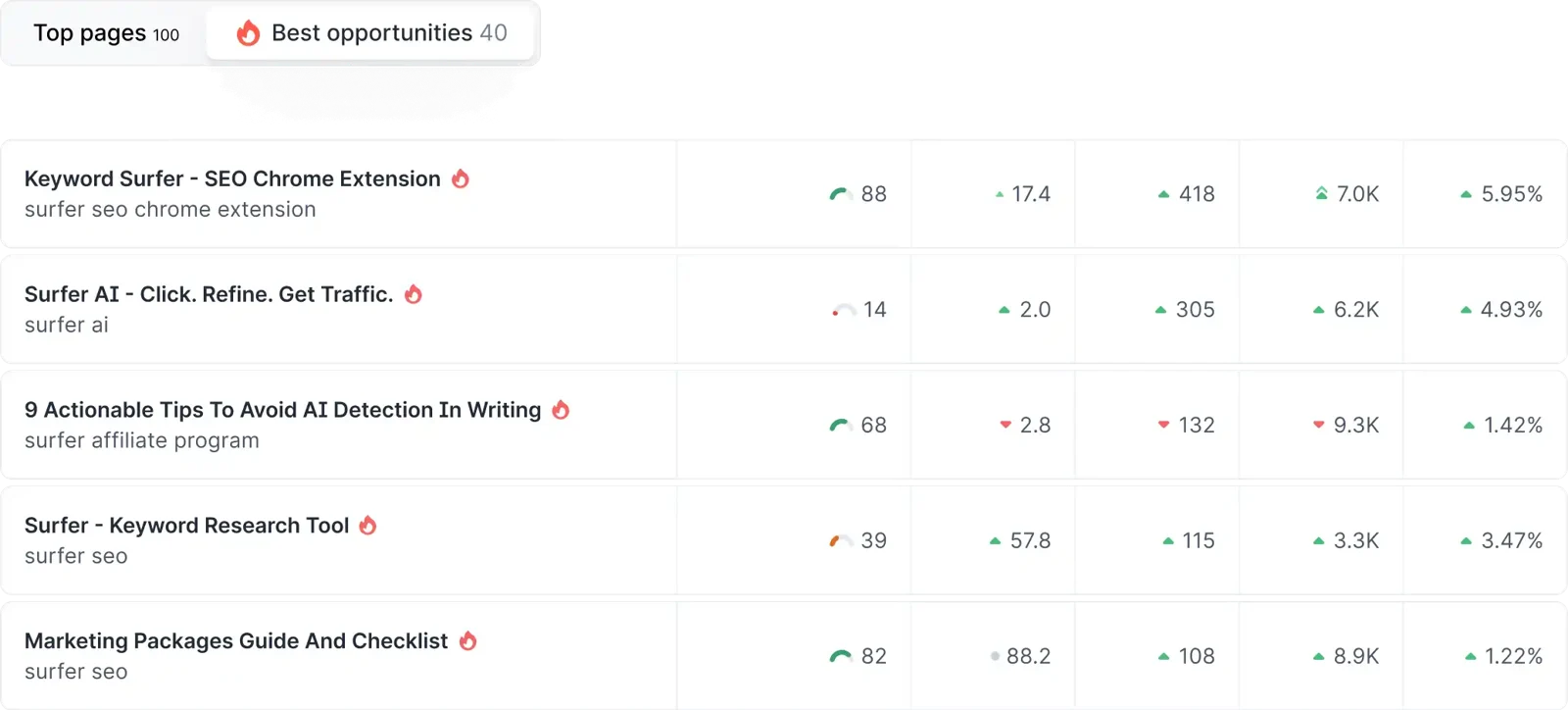
Our prioritization approach: first ask whether the page is indexed, still matches the query and has genuinely outdated or incomplete information. Then weigh business relevance, current demand, realistic effort and the existing page's potential. A falling position can result from intent shifts, technical issues or stronger competitors—not simply missing words.
Keep branded and non-branded performance separate, inspect the actual landing page and annotate publication dates. If you revise ten articles and traffic rises, that alone does not identify which edit caused the change. Search updates, seasonality and changing SERP layouts can influence the same window.
4. Topical Map: organize a useful coverage plan
Topical Map explores topic clusters, competitor coverage and gaps. It is useful for grouping related reader needs and deciding where your site should offer a substantial answer. The current Pro offer explicitly lists content ideas and coverage gaps; do not assume every planning capability is unlocked in Discovery merely because a product page describes it. [4] [1]

Added value: map topics to existing URLs before creating new pages. Several related questions may belong in one strong resource. Where two URLs compete for the same intent, consider consolidation or clearer differentiation rather than adding a third. Pro's advertised cannibalization report can support this review; confirm findings against Search Console and the real SERP.
5. Auto-Optimize and internal linking: assist execution, retain approval
Auto-Optimize can add relevant terms or missing sections and rewrite portions of a draft. The product page says a fresh editor and at least 50% of the suggested content length are prerequisites for this workflow. Automatic internal linking scans the domain for candidate links and anchors. Standard advertises one-click optimization; Pro explicitly adds one-click internal linking. [2] [1]
Review the changes as carefully as a contributor's draft. An inserted sentence may be fluent but factually wrong; a suggested anchor may send readers to an obsolete or commercially inappropriate page. Check destination status, relevance and whether the link duplicates another nearby link. Keep an approved previous version so you can recover from a poor edit.
6. Collaboration and publishing integrations: fit the team's real process
Surfer describes shareable editors, comments and version history. Share links allow external contributors to work without your account password—useful for agencies, but access should still be controlled. Standard lists Google Docs and WordPress integrations; Pro adds Contentful, while Peace of Mind also lists Zapier. [2] [1]
Test one actual article through the full handoff: brief, contributor, edit, approval and publication. Confirm that headings, links, media and metadata survive your specific publishing setup. Sharing an editor does not necessarily mean unlimited full-account seats; verify user roles and permissions separately.
7. Advanced analysis and integrations: avoid paying for unused access
Peace of Mind advertises advanced SERP analysis, API access, personalized onboarding and a success manager. Pro and higher advertise MCP, which connects Surfer to assistant-driven workflows. Enterprise adds custom limits, SSO, white-label and advisory features. These may matter for a large agency; they are not automatic reasons for a solo publisher to upgrade. [1] [7] [8]
A documented API entitlement does not establish unlimited automation or that every feature can be called programmatically. Ask about endpoints, authentication, quotas, export scope and what happens when a workflow exceeds a limit. A production integration should be evaluated on a real repeatable task, not a demo alone.
AI writing, GEO and AEO: useful assistance with editorial safeguards
Surfy, Brand Knowledge and custom writing styles
Surfy helps edit, expand and rephrase text inside the content workflow. Brand Knowledge provides brand-specific context; higher plans advertise custom voices and templates. These are useful ways to reduce generic drafting, especially when you provide concrete approved facts and examples. They do not guarantee factual accuracy or reproduce genuine firsthand experience. [2] [1]
Before using AI: provide a source pack, state which claims cannot be inferred and mark any missing facts for human resolution. For product reviews, distinguish vendor descriptions from direct observations. Never let a model invent a testing period, customer story, benchmark or quotation to fill a content gap.
Humanizer and plagiarism checks are not quality guarantees
Surfer markets Humanizer for more natural language and avoiding AI detection. We treat it as a style aid, not a way to establish authorship, evade accountability or guarantee search compliance. A plagiarism check can flag overlap; it cannot establish that a rewritten passage is accurate, permissioned or useful. [2]
For sensitive topics, require an appropriately qualified reviewer. Confirm every price, specification, legal statement and statistic against a reliable source. Preserve uncertainty when evidence is incomplete. A naturally written false claim remains a false claim.
Connect content work to AI visibility without confusing outcomes
Content tools can support clearly organized answers, comparisons and accurate facts that both people and retrieval systems can use. Some Surfer bundles also track AI mentions. Standard's 25 prompts refresh weekly in ChatGPT only; Pro has 50 daily prompts across five listed platforms; Peace of Mind has 100 daily prompts. [1] [6]
That is a measurement entitlement, not proof that the editor causes citations. Track Google impressions/clicks, AI mentions, owned-page citations and identifiable referrals separately. For collection methodology, engine coverage and prompt budgeting, read the dedicated AI Search Analytics review and our AI visibility vs. traditional SEO guide.
How to interpret Content Score without chasing the wrong target
| Signal | Useful question | What it does not prove |
|---|---|---|
| Content Score | How closely does the draft align with selected recommendations? | A Google quality score, ranking forecast or business return. |
| Terms / Topics | Have we omitted a relevant concept or reader question? | That every suggested phrase must appear repeatedly. |
| Length / structure ranges | Does this page's format differ from relevant competitors? | That matching a word count makes the answer better. |
| Audit opportunity / position changes | Which existing pages deserve investigation? | That content alone caused the movement. |
| Cannibalization signal | Could overlapping URLs be competing for the same intent? | That merging pages is always the right action. |
| AI mentions / citations | Does a tracked answer sample include the brand or page? | Organic clicks, revenue or causal lift from optimization. |
A better acceptance test: the page answers the intended question, adds original information, accurately cites its facts, clearly states limitations and offers an appropriate next step. Check those conditions first; use Surfer to expose any overlooked coverage. Do not require a perfect score if achieving it would make the answer padded or repetitive.
Record the query, market, selected competitor context, baseline page and change date. Compare performance for the same query segment over a meaningful period. Repeatedly changing the target and the content makes it harder to learn what worked.
Surfer pricing in November 2026: the plan differences that matter
These are the advertised USD annual offers, with the entire year paid upfront. The month-to-month amounts are inferred from the stated annual savings, not a separately verified monthly checkout. Taxes and selected add-ons may change the bill. Confirm your final offer before purchase. [1]
| Plan | Annual monthly equivalent | Implied monthly billing | Published annual document allowance / main difference |
|---|---|---|---|
| Discovery | $49 ($588/year) | $59 | 120 documents; 10 tracked pages; entry content tools; no AI tracking |
| Standard | $99 ($1,188/year) | $119 | 360 documents; collaboration, Docs/WordPress, one-click optimization; 25 weekly ChatGPT prompts |
| Pro | $182 ($2,184/year) | $219 | 360 documents; internal links, content gaps, cannibalization, Contentful, MCP; 50 daily AI prompts |
| Peace of Mind | $299 ($3,588/year) | $359 | Unlimited* documents; API, advanced SERP analysis, onboarding; 100 daily prompts |
| Enterprise | Custom | Custom | Negotiated limits, SSO, white-label, security and advisory |
| AI Search Analytics | $82 ($984/year) | $95 | Tracking-only: 50 daily prompts; no Content Editor |
Monthly-price arithmetic: Discovery: ($588 + $120 savings) ÷ 12 = $59; Standard: ($1,188 + $240) ÷ 12 = $119; Pro: ($2,184 + $444) ÷ 12 = $219; Peace of Mind: ($3,588 + $720) ÷ 12 = $359. These assume the displayed savings compare the same configuration and exclude taxes or promotions.
Document capacity: Standard and Pro are not different volume tiers
On the annual offer, Discovery's 120 documents equal an average planning pace of 10 per month; Standard and Pro's 360 equal 30 per month. Those averages are not monthly resets: Surfer says annual credits reset yearly or after a plan change. Confirm what creates a new billable document, whether a fresh analysis of an old URL consumes another document and how generation is counted. [1]
Illustrative workload: 12 new articles plus 8 refreshes each month means 240 document tasks over a year if each uses one document. That exceeds Discovery's 120 and fits Standard or Pro's 360 before reanalyses and other work. Pro adds $996/year over Standard ($2,184 − $1,188) without increasing that headline allowance. Buy it for the additional features or daily AI coverage, not a presumed larger pool.
“Unlimited” has explicit fair-use ceilings
The November 16 fair-use policy sets Peace of Mind documents at 500/month on a monthly plan or 6,000/year on an annual plan. It describes a one-time reset request through a success manager if the limit is reached early; approval should not be assumed. Explicit limits in your plan take precedence over the general policy. [5]
| Feature | General fair-use guideline | Important qualification |
|---|---|---|
| Auto-Optimize | 100/day | Applies where no explicit plan limit is stated |
| Auto Internal Linking | 100/day | Requires feature entitlement first |
| Brands / domains | 100 total | A plan's explicit brand-space limit overrides this |
| Humanizer | 50,000 words/month or 600,000/year | Monthly vs. annual plan; explicit limits override |
| Peace of Mind documents | 500/month or 6,000/year | Not an unrestricted publishing or generation license |
“Unlimited brand spaces” therefore does not mean arbitrary enterprise-scale monitoring. Prompt capacity is a separate constraint. Ask for a written configuration if you manage many clients, automate frequent reanalysis or expect seasonal bursts. [1] [5]
Trials, unused credits and annual commitment
The pricing page advertises “Start for Free” checkout links, but its public copy does not establish a universal trial length, card requirement or refund rule. We do not repeat the category's former seven-day money-back claim as a verified guarantee. Confirm your renewal amount, cancellation deadline, unused-credit treatment and refund conditions at checkout. [1]
Subscription price is only part of the budget. Add editors, expert review, media, publishing and the technical or keyword-research tools the team still needs. The economically useful question is whether Surfer improves a recurring editorial decision—not whether a generated draft costs less than a fully researched article.
Explore Surfer & current plansPros and limitations: our editorial assessment
Reasons to shortlist
- Live guidelines make potential coverage gaps visible while editing.
- Existing-page import connects refresh work to the writing process.
- Search Console-connected audit supports a focused improvement queue.
- Topic clusters and competitor coverage can organize editorial planning.
- Collaboration and eligible publishing integrations reduce handoff friction.
- AI assistance can accelerate reviewable drafts and repetitive revisions.
- Higher bundles connect content work with AI visibility measurement.
Reasons to hesitate
- Scores and suggested ranges can encourage over-optimization.
- Not a full backlink database or specialist technical crawler.
- Pro and Standard have the same advertised annual document volume.
- Annual billing requires upfront commitment; credits reset yearly.
- Unlimited claims remain subject to fair-use ceilings.
- Feature pages describe capabilities not included on every plan.
- AI drafts and automatic edits require factual and editorial checks.
- Public trial and refund terms need checkout verification.
These are judgments about documented scope and buying trade-offs, not claims of experienced bugs, slow support or measured ranking failures. The strongest value depends on whether your team can turn recommendations into better published pages.
A practical 30-day Surfer evaluation plan
Illustrative evaluation—not an AIToolRush case study. Imagine an in-house B2B content team with a small monthly publishing budget and several established pages. Thirty days can assess workflow fit; it cannot prove durable SEO revenue or a universally reliable ranking uplift.
Week 1: establish fit, access and a clean baseline
Choose one existing commercial page and one new supporting topic. Record their intent, relevant queries, indexed URL, Search Console performance and conversion context. Connect only the data permissions the workflow needs. Test a real contributor handoff and verify that the selected plan includes the integration and analysis features you expect.
Week 2: create a brief with original evidence
Review the competitor context and use the guidelines to identify real information gaps. Write an outline around buyer questions, not keyword repetition. Supply original screenshots, product facts or subject-matter input. Log recommendations you reject and why; this reveals whether the tool is helping make better decisions or simply adding revision work.
Week 3: refresh, approve and publish
Import the existing page, update outdated facts and resolve the most important missing question. If using automatic optimization, review the changes and verify citations, claims and internal links. Preserve the previous version, publish through the normal approval process and check the live page's headings, media, links and indexability.
Week 4: measure operational value before extrapolating growth
Review editor and writer effort, unresolved corrections, document consumption and publishing friction. Inspect Search Console for the fixed query segment while noting seasonality and search changes. On an eligible AI plan, keep the prompt set stable and record mentions separately. Early search movement is an observation, not proof of causation.
A useful go/no-go test: can the team produce a clearer brief and a more accurate page, complete the handoff, stay within allowances and identify the next worthwhile refresh? If the only improvement is a higher score, the subscription has not yet demonstrated meaningful value.
Surfer vs. Semrush, Ahrefs, Clearscope, Frase and free tools
| Primary bottleneck | Candidate to evaluate | Decision to test |
|---|---|---|
| Briefing and revising pages | Surfer / Clearscope / Frase | Which turns evidence into a reviewed page with less friction? |
| Competitor keywords, backlinks, broad SEO diagnosis | Semrush / Ahrefs | Which research coverage and workflow fits the market? |
| Technical crawling and rendering | Specialist crawler / technical suite | Can it diagnose the real templates and indexing problem? |
| Own-site search performance only | Search Console + analytics | Is paid competitive or content analysis actually needed? |
| Prompt-level AI monitoring only | AI Search Analytics / dedicated tracker | Do engine, market and reporting limits match the job? |
Surfer vs. Semrush: editor-first vs. a wider SEO program
Choose the shortlist based on your recurring work. Surfer's case is an editorial-focused environment for creating and refreshing content. Semrush is the broader candidate for keyword intelligence, backlinks, technical audits and daily ranking campaigns. Buying both can be reasonable for an active team; it is unnecessary if there is no implementation capacity. Read our Semrush SEO review.
Surfer vs. Ahrefs: content execution vs. research-led decisions
Ahrefs is worth evaluating for competitor page and backlink research, keyword context and technical auditing. Surfer belongs in the comparison when research is already available and the bottleneck is converting it into a useful page. Check the current content/AI add-ons rather than assuming every Ahrefs plan includes equivalent editorial access. Read our Ahrefs SEO review.
Surfer vs. Clearscope: test the same writer and brief
Both belong on an editorial content-optimization shortlist. Bring one real article, one writer and the same source pack. Compare the relevance of suggestions, ease of collaboration, included usage and publishing integration. Do not decide purely by which tool gives the draft a higher score; their grading systems are not interchangeable. Read our Clearscope review for current credits, monitoring and AI scope.
Surfer vs. Frase: compare the research-to-brief handoff
Frase is a candidate for SERP-led research and content briefs. Surfer's connected audit-to-editor process matters when refreshing established content is central. Evaluate how quickly each creates an accurate assignment, not merely a long outline. Verify current writing allowances and workflow access in the actual plan. Read our Frase review for its current content, maintenance and automation scope.
Surfer vs. free first-party tools: pay for the missing decision
Search Console and analytics already help reveal where your own pages gain or lose search attention. They do not supply the same competitor-informed editorial environment, but a small site with occasional publishing may not need it. Start free if the task is simply updating a clearly outdated page. Pay for Surfer when its guidance and workflow solve a repeated bottleneck.
If you only need AI answer tracking, do not purchase an editorial bundle by default. Our Surfer AI Search Analytics review evaluates the standalone option. For the broader SEO shortlist, see the full AI SEO tools guide.
Before you buy: a practical Surfer checklist
- Primary task: Do we need content execution, broad SEO intelligence or tracking-only?
- Capacity: Count new pages, refreshes and reanalyses—not only published articles.
- Credit behavior: Confirm what consumes a document, generation allowances, reset timing and unused-credit treatment.
- Features: Are optimization, internal linking, topics, cannibalization and required analysis included in this tier?
- Team: Verify full users, share-link permissions, comments, version history and access revocation.
- Publishing: Test the real Docs, WordPress or CMS handoff with media and metadata.
- Data: Validate Search Console property access and the tracked-page allowance.
- AI scope: Are weekly ChatGPT samples enough, or do we actually need daily multi-engine tracking?
- Scale: Check fair-use rules and contracted API or automation limits.
- Terms: Confirm trial, renewal, annual upfront charge, cancellation and refunds.
- Accountability: Assign the editor who checks claims and the person who publishes changes.
Decision rule: choose the lowest plan that supports your actual editorial process. Upgrade when a specific included feature or documented capacity resolves a recurring constraint—not because a higher tier sounds more advanced.
Surfer review: frequently asked questions
Sources, evidence and editorial methodology
We researched Surfer's official pricing, content product pages and fair-use policy on November 21, 2026. Document counts refer to the displayed annual offers. Monthly-price arithmetic is explicitly labeled; final checkout, account entitlements and custom terms take precedence.
Images are official illustrative product visuals, not evidence of our own paid account. We have not measured traffic or citation lift, audited score methodology, tested customer support or run a controlled comparison. Recommendations are editorial judgments based on documented capabilities and practical trade-offs; examples are labeled as hypothetical.
- Surfer current pricing
Advertised annual prices, document allowances, plan-specific features, annual upfront billing and credit resets. Monthly equivalents below are inferred from stated yearly savings.
- Surfer Content Editor
Content Score, competition-based guidelines, Outline Builder, Surfy, Auto-Optimize, internal links, collaboration and official editor screenshot.
- Surfer Content Audit
Search Console connection, opportunity selection, ranking changes, refresh workflow and official illustrative screenshot.
- Surfer Topical Map
Topic exploration, clusters, competitor coverage and content gaps.
- Surfer Fair Usage Policy
Updated November 16, 2026: Peace of Mind document ceilings, optimization/linking limits and when explicit plan limits take precedence.
- Surfer AI Tracker
AI tracking and official topical-map visual. This review discusses the content-to-measurement connection, not a complete AI tracker evaluation.
- Surfer Enterprise
Custom scale, security, SSO, white-label and advisory-led offerings; confirm contracted entitlements.
- Surfer MCP
Assistant-connected workflows; availability is plan-dependent.
See our review methodology and affiliate disclosure. Found a changed plan or feature? Send a correction.
The bottom line: buy a better content process, not a higher score
Surfer is a compelling candidate when an active team needs to turn content research into clear briefs, reviewed drafts and targeted refreshes. Its guidelines and connected workflow can support that process, but the team still supplies original evidence, editorial judgment and implementation.
Our recommendation: evaluate Discovery for modest content needs, Standard for a collaborative 360-document annual workflow, and Pro when its extra planning, linking or daily AI monitoring is genuinely required. Consider Peace of Mind for documented scale or API needs, with fair-use ceilings understood. Keep broader SEO tools where technical or backlink work remains important.