AI SEARCH VISIBILITY · SOURCE-VERIFIED REVIEW
Scrunch Review: Pricing, Agent Pages and a Practical GEO Verdict for 2026
Most AI-visibility tools tell you how you appear in ChatGPT or Perplexity. Scrunch also looks at the other side of the conversation: which AI agents visit your website, what they can read, and—on Enterprise—what optimized version of each page they receive. Since June 2026 it is a Sitecore company. The buying question is whether you need that website layer, and whether 15,000 responses a month covers your real prompt set.

Lead SEO & AI Specialist · 13+ years in SEO
Published & fact-checked November 21, 2026 · 19 min read
In this review
The short answer: shortlist Scrunch when your website is part of the problem
Scrunch is worth evaluating if you want AI-answer monitoring and a clear view of how AI agents actually consume your site. Its Agent Traffic, Site Optimization and Agent Pages products make it one of the few platforms that connect “how we appear in answers” with “what bots can read on our pages.” It is less compelling for solo consultants or teams that only need a low-cost prompt tracker.
- Best fit
- Mid-market and enterprise brands with JavaScript-heavy sites; agencies selling AI-search services.
- Current entry plan
- Core $250/month: 15,000 responses, 8 AI platforms, 1 brand, 5 seats, daily collection. [1]
- Standout
- Agent Traffic + Site Optimization on Core; Agent Pages delivery on Enterprise.
- Main caution
- API, Agent Pages, Claude and unlimited brands sit behind custom Enterprise pricing.
Evidence note: This is a public-source review, not a paid-account benchmark. We have not independently tested collection accuracy, Agent Pages impact, support or revenue lift. Vendor case-study percentages are reported as vendor claims, and no invented score or customer outcome is used.
What is Scrunch—and what does it measure?
Scrunch describes itself as an AI customer-experience platform. Its product menu has two halves: Monitoring & Insights (Monitoring & Citations, Insights, Shopping, AI Search Trends) and Agent Experience (Agent Pages, Agent Traffic, Site Optimization). [2] [6]
Sitecore announced the acquisition on June 3, 2026; Bloomberg reported a deal value of about $225 million. Scrunch continues to sell its own Core and Enterprise plans. [15] [16]
GEO (generative engine optimization) and AEO (answer engine optimization) both aim to make accurate, useful information discoverable in AI answers. Scrunch, like every tool here, cannot control those answers. It samples responses, measures what appears and—uniquely—can change what AI bots receive from your site.
Keep five signals separate: brand mentions, citations, AI-bot visits, AI referral visits and conversions. Scrunch counts brand presence only when the brand is explicitly mentioned in the answer text, not when it merely appears in a cited URL. [9] For background read what GEO means and AI visibility vs. traditional SEO rankings.
Scrunch features in detail: where the added value is
1. Monitoring & Citations: presence, competitors and an Explorer BI layer
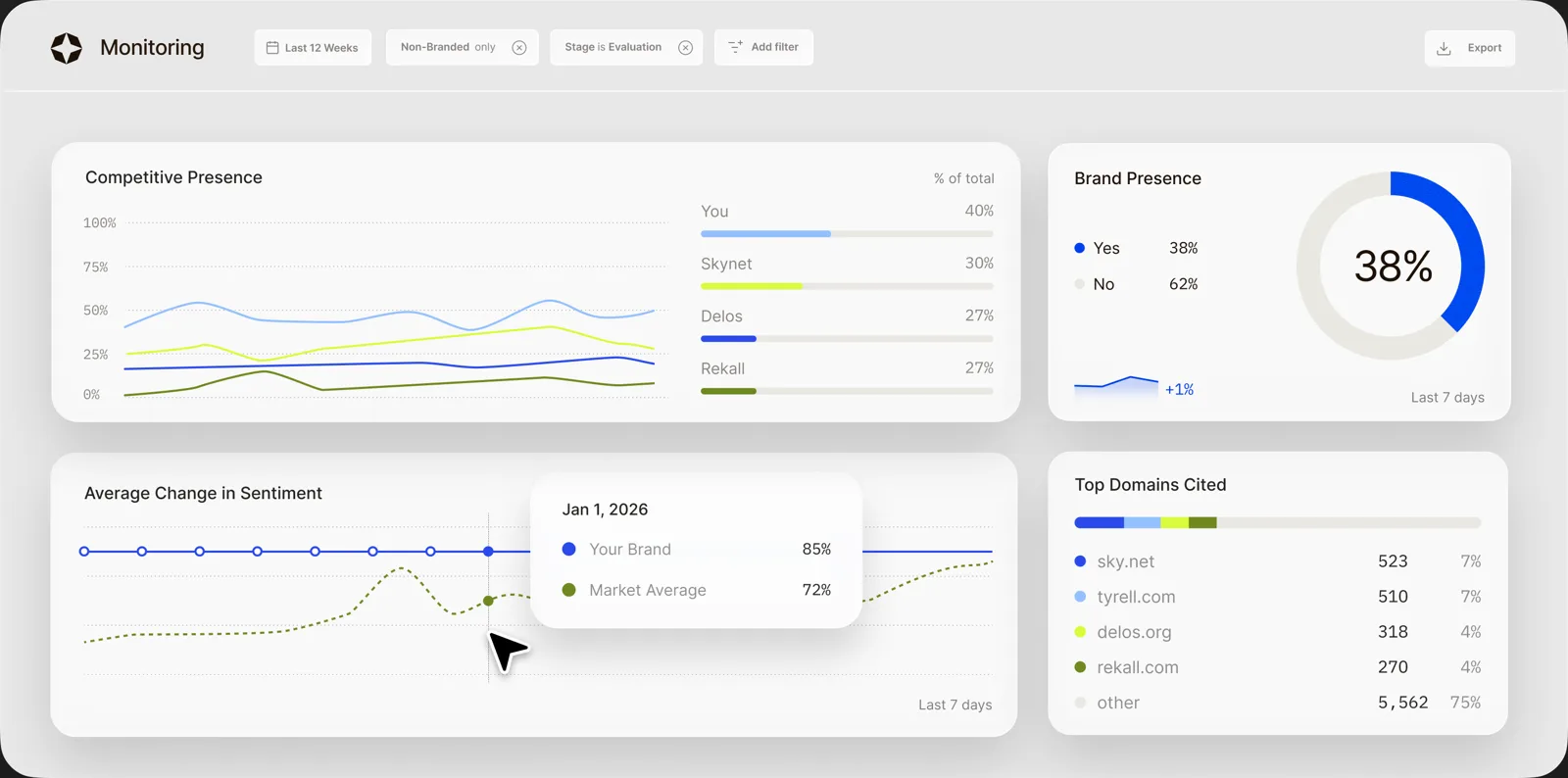
Monitoring shows brand presence, competitive presence, sentiment and top cited domains over time. Explorer is described as a “fully composable BI layer” that lets you mix metrics, filters and breakdowns—or query the data conversationally through the Scrunch MCP. [2] Filters include personas, countries, languages and funnel stages, all listed on Core. [1]
Practical value: separate non-branded evaluation-stage prompts from branded ones. A 38% presence on “best payroll software for startups” matters far more commercially than 95% on “what is [your brand].” Funnel-stage tagging makes that split repeatable.
Data comes from browser automation and official platform APIs, chosen per platform, and validated against a reference dataset collected inside the AI interfaces. [8] Ask in a demo which method applies to each engine and country you care about, because interface and API answers can differ.
2. Citation targets and Insights: from data to a recommended change
Insights explains “what happened, why it matters, and what to do,” pairing a current issue (for example, no comparison against competitors) with a recommended change and suggested competitors. Core includes 10 citation targets per month; Enterprise is unlimited. [3] [1]
Treat a recommendation as a hypothesis. Check the underlying answers and cited sources, decide whether the fix is an owned-page change or a legitimate third-party correction, and log the date you shipped it.
3. Agent Traffic: see the AI bots already reading your site
Agent Traffic breaks down visits from ChatGPT, Claude, Gemini, Perplexity and others, separates signal from noise, and highlights the content bots rely on. Detection uses CDN and hosting integrations and classifies training, indexer and retrieval bots. Core covers one domain; Enterprise covers multiple. [4] [10] [1]
Why it matters: retrieval bots fetch pages for live user questions, so a spike on your pricing page from a retrieval agent is a different signal from a training crawl. It is still not a human visit and not proof of a citation. Confirm that your CDN is supported before you plan around this feature.
4. Site Optimization: an AI-readiness audit per page
Site Optimization maps your pages, shows agent traffic and an audit score per URL, diagnoses blockers such as JavaScript rendering issues and gives prioritized recommendations. Core includes 10 pages optimized and 10 pages generated per month, plus 100 fact-checked pages. [5] [1]
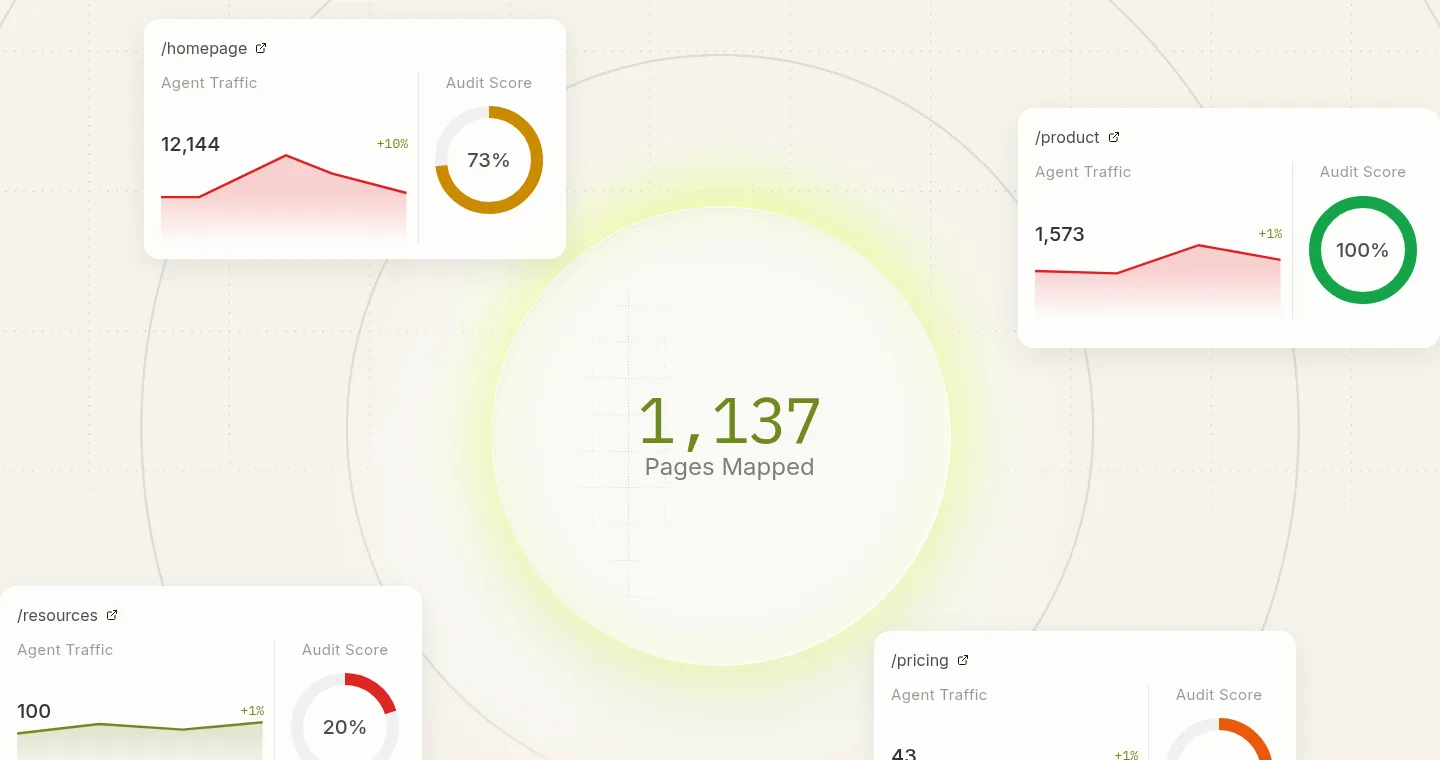
The useful combination is traffic × score: a pricing page that AI agents request often but that renders poorly without JavaScript is a higher priority than a rarely crawled blog archive.
5. Agent Pages: AI-optimized delivery at the edge (Enterprise)
Agent Pages detects AI visits in real time and serves AI-optimized versions of your pages—“technically sound, properly structured, and contextually enriched”—while humans get the normal site. No CMS changes are required. Scrunch's demo shows token reductions on example pages. [6] On the current pricing table, pages served via Agent Pages are an Enterprise line item; Core has none. [1]
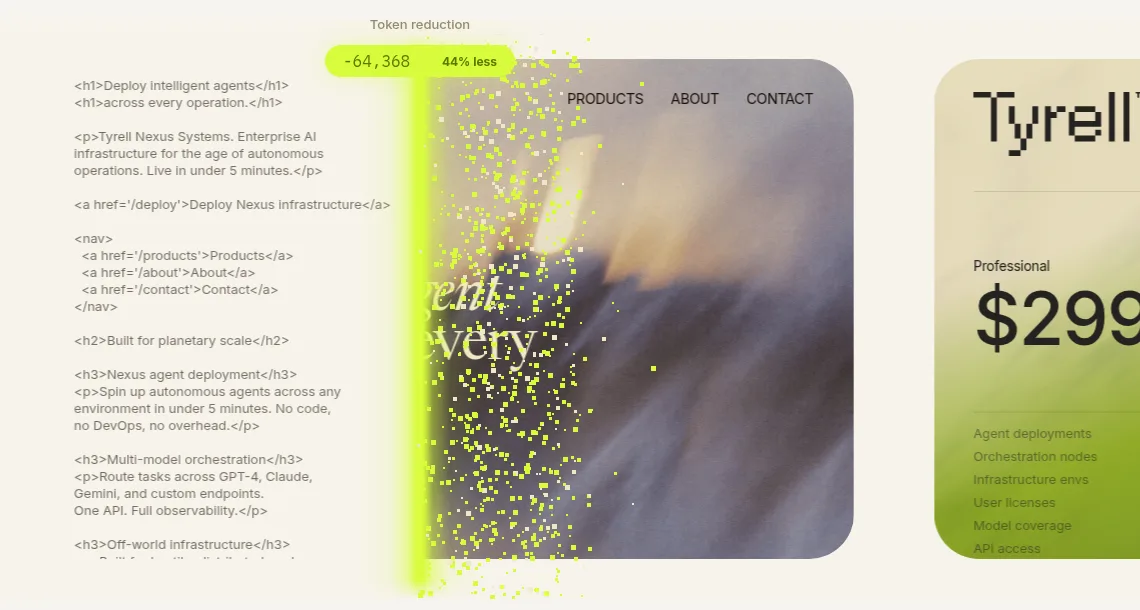
This is the most distinctive—and most sensitive—feature. See the risk check below before enabling it.
6. AI Shopping: product-level visibility
Shopping tracks which products appear in AI answers, their position, competitor share and the prompts that drive recommendations. [7] Verify which engines and markets feed product data, and confirm catalog matching for variants and bundles before trusting SKU-level conclusions.
7. AI Search Trends and volume estimates
Trends estimate topic-level AI search demand from a third-party panel and proprietary modeling. Scrunch itself calls the data directional, not exact, because AI platforms do not publish query volume. Core includes 3 topics. [12] [1] Use it to prioritize themes, never as a forecast of visits.
8. Workspace, MCP and data access
Core includes exports, MCP, Google SSO, five sub-brands and five competitor sub-brands per brand. API keys, Data Studio, SAML/OIDC SSO, security review, Slack support and a dedicated CSM are Enterprise. [1] The agency program adds multi-client workspaces, prospecting environments and white-label/API options. [14]
How to read Scrunch's metrics without overstating the result
Every Scrunch chart depends on its prompt set, platforms, personas, countries and dates. Keep those visible in every report. [2] [9]
| Signal | What it helps answer | Do not infer |
|---|---|---|
| Brand presence | Share of responses that explicitly mention the brand. | Market-wide awareness or an endorsement. |
| Competitive presence | Your presence relative to tracked competitors. | A score comparable across different competitor sets. |
| Sentiment | Direction of tone in mentions over time. | Customer satisfaction or NPS. |
| Top domains cited | Which sources answers reference most. | That each source caused your inclusion. |
| Agent traffic | AI bot requests by agent type and page. | Human visits or confirmed answer usage. |
| Audit score | AI-readiness of a page against Scrunch's checks. | A ranking factor any engine has confirmed. |
| AI search volume | Directional topic demand. | Exact monthly query counts. |
| AI referrals | Identifiable visits from AI assistants. | All AI influence or incremental revenue. |
Our reporting rule: pair every presence change with the raw answers behind it and a log of what you shipped. Use LLM citation analytics to turn source data into research rather than causal claims.
Scrunch pricing in November 2026: think in responses, not prompts
Scrunch publishes one self-serve plan and one custom plan for brands; agency pricing is handled separately. [1] [14]
| Core | Enterprise | |
|---|---|---|
| Price / billing | $250/month, monthly; 7-day trial | Custom, yearly |
| AI responses | 15,000 per month, daily | Custom; daily or every 3 days |
| AI platforms | 8 (ChatGPT, Perplexity, Gemini, AI Overviews, AI Mode, Copilot, Grok, Meta AI) | Same 8 + Claude add-on |
| Competitors / trends | 5 competitors; 3 trend topics | Unlimited |
| Citation targets | 10 per month | Unlimited |
| Pages optimized / generated | 10 / 10 per month | Custom |
| Agent Pages delivery | — | Custom number of pages |
| Agent Traffic | 1 domain | Multiple domains |
| Brands / seats | 1 brand / 5 seats | Unlimited |
| API / Data Studio | — (exports + MCP included) | Included |
| Support | Email; self-serve onboarding | Email, chat, shared Slack; dedicated CSM |
How far do 15,000 responses go?
A response is one collected AI answer. Daily collection across all eight platforms uses about 240 responses per prompt per month (8 × 30), so 15,000 responses cover roughly 62 prompts in one market and persona. Track four platforms instead and you can run about 125 prompts. Add a second country or persona and the number halves. This is our illustrative arithmetic, not a vendor quote—confirm how Scrunch counts retries, personas and regions.
Agencies and multi-brand teams
Core includes one brand. Scrunch says it offers special agency pricing and an Agency Partner Program, but does not publish a price. [14] Ask for per-client response pools, prospecting environments and white-label terms in writing.
What to verify before paying
Check what happens when you exceed your response limit, whether annual pricing is available for Core, and the trial's card and cancellation terms. [13] If Agent Pages is the reason you are buying, you are buying Enterprise.
Try Scrunch free for 7 daysAgent Pages: a risk check before you switch it on
Serving AI bots a different version of a page than humans see sounds like cloaking. Scrunch argues it is not: Agent Pages targets LLM retrieval bots only—not Googlebot or Bingbot—and optimizes for clarity, not deception. [11] That is the vendor's position, not a statement from Google, OpenAI or any other platform.
- Keep facts equivalent. Prices, claims, availability and disclaimers in the agent version should match the human page.
- Audit the output. Request samples of what each bot receives and keep a versioned record.
- Confirm bot targeting. Understand how traditional search crawlers and mixed-purpose agents are handled.
- Plan a rollback. Know how to disable delivery per page or sitewide.
- Involve stakeholders. SEO, legal and the team responsible for regulated content should sign off.
Used carefully, Agent Pages can fix a real problem for JavaScript-heavy sites. Used carelessly, it creates a second version of your website that nobody reviews.
Pros and limitations: our editorial assessment
Reasons to shortlist
- Eight AI platforms on the entry plan, including Copilot, Grok and Meta AI.
- Agent Traffic and Site Optimization connect answers to your website.
- Agent Pages is a distinctive delivery layer for JavaScript-heavy sites.
- Personas, countries, languages and funnel stages on Core.
- Explorer and MCP for flexible self-serve analysis.
- Agency workflows and Sitecore backing.
Reasons to hesitate
- $250/month entry with no smaller plan.
- Agent Pages, API and Data Studio require Enterprise.
- Claude is only an Enterprise add-on.
- 15,000 responses go quickly across many platforms and markets.
- Agent Pages carries policy and governance questions.
- Independent accuracy, support and ROI are unverified here.
We do not repeat review-site ratings or customer counts we cannot verify, and we treat vendor case-study percentages as claims, not benchmarks.
A practical 30-day Scrunch evaluation plan
Illustrative workflow—not an AIToolRush case study. Imagine a B2B SaaS team using the 7-day Core trial, then one paid month.
Week 1: baseline and capacity math
Build 40–60 prompts from sales calls and support tickets, tagged by funnel stage and branded/non-branded. Pick the platforms your buyers use, calculate monthly responses, and connect your CDN for Agent Traffic. Save the baseline.
Week 2: connect answers to pages
Find non-branded evaluation prompts where competitors appear and you do not. Open the cited domains, then check Agent Traffic and audit scores for your matching pages. Look for heavily crawled pages that score poorly.
Week 3: ship a few reviewed fixes
Use your 10 optimized pages on the highest-priority URLs: fix rendering, add clear comparison and pricing facts, and use citation targets to plan legitimate third-party corrections. Record every change and its date.
Week 4: test repeatability—and Agent Pages, if relevant
Compare the same prompts and platforms over equal periods and read changed answers. If Agent Pages is on the table, ask for an Enterprise pilot on a few pages with reviewed output. Keep referrals and conversions separate from presence.
A defensible success criterion: the team can trace a missed answer to a specific page problem, fix it and monitor the result without confusing bot visits, citations and customers. Prepare with our prompt-selection framework and AI search visibility playbook.
Scrunch vs. Profound, AthenaHQ, Peec AI and Nightwatch
Compare the recurring job, matched collection scope and total cost—not a single accuracy winner.
Scrunch vs. Profound
Both target larger brands. Profound is a broad enterprise AI-search program with custom pricing; Scrunch publishes a $250 Core plan and leans into the website side with Agent Traffic and Agent Pages. Read the Profound review.
Scrunch vs. AthenaHQ
AthenaHQ uses a credit model with a free Essential tier and a $295 Starter plan. Scrunch's response pool and site layer suit teams that want to fix how bots read their site. Read the AthenaHQ review.
Scrunch vs. Peec AI
Peec AI starts at $95/month with three active models and a strong Actions and content workflow. Scrunch tracks eight platforms on Core and adds agent analytics, at a higher entry price. Read the Peec AI review.
Scrunch vs. Nightwatch and AIclicks
Nightwatch combines classic rank tracking with AI visibility in one SEO toolkit; AIclicks pairs monitoring with content. Neither positions an edge delivery layer like Agent Pages. Read the Nightwatch review or the AIclicks review.
For the full shortlist, see our AI search visibility tools comparison.
Questions to answer before buying Scrunch
- Capacity: How many prompts × platforms × personas × countries fit in our response pool?
- Collection: Browser automation or API for each platform and market?
- Evidence: Can we open full answers, timestamps and cited URLs for every data point?
- CDN fit: Is our CDN/hosting supported for Agent Traffic, and what data is shared?
- Agent Pages: What exactly do bots receive, who reviews it, and how do we roll back?
- Claude and API: Do we need them—and therefore Enterprise?
- Agency terms: Per-client pools, pitch environments, white-label and client isolation.
- Overages: What happens when we exceed responses, citation targets or pages?
- Sitecore roadmap: Standalone availability, data processing and contract continuity.
- Exit: Which exports remain available after cancellation?
Decision rule: start with Core if monitoring and site diagnostics are enough. Move to Enterprise only for a proven need—Agent Pages, API, Claude or multiple brands.
Scrunch review: frequently asked questions
Sources, evidence and editorial methodology
This review was researched against Scrunch's official pricing, product pages and FAQs, plus Sitecore's announcement and Bloomberg's report, on November 21, 2026. Images are official Scrunch product visuals with fictional example brands; they do not show our account or measured performance.
We assessed scope, metric clarity, capacity economics, governance and workflow fit. We did not access a paid account or audit accuracy, Agent Pages impact, support or revenue. The response-capacity math is our own illustration.
- Scrunch pricing
Core and Enterprise entitlements: responses, platforms, citation targets, pages, seats, integrations, security and support.
- Monitoring & Citations
Brand presence, competitive benchmarks, Explorer BI layer and MCP; official dashboard visual.
- Insights
Issue/recommendation workflow and competitor suggestions.
- Agent Traffic
AI-agent visits by model, signal vs. noise and top content.
- Site Optimization
How AI agents access and navigate pages; prioritized fixes; official visual.
- Agent Pages
Detecting AI visits and serving AI-optimized page versions at the edge; official token-reduction visual.
- AI Shopping
Product-level visibility, position and competitor share in AI answers.
- FAQ: data collection methods
Browser automation and official platform APIs, chosen per platform.
- FAQ: brand presence accuracy
Binary presence; explicit brand mentions only, not citation-only appearances.
- FAQ: AI bot detection
CDN/hosting integrations; training, indexer and retrieval bot categories.
- FAQ: Agent Pages and cloaking
Vendor position: targets LLM retrieval bots, not Googlebot or Bingbot.
- FAQ: AI search volume
Topic-level panel-based estimates; directional, not exact.
- FAQ: free trial
7-day self-serve trial of Core.
- FAQ: agency pricing
Special agency pricing and an Agency Partner Program.
- Sitecore press release
June 3, 2026 acquisition announcement.
- Bloomberg on deal value
Reported value of about $225 million, from people familiar with the matter.
See our review methodology and affiliate disclosure. Found a change? Send a correction.
The bottom line: monitor the answers, then fix what bots read
Scrunch's strongest case is the link between AI answers and your own website: eight platforms of monitoring, agent traffic, per-page audits and, on Enterprise, an optimized delivery layer for AI bots.
Our recommendation: shortlist it if your site is complex or JavaScript-heavy and you have people to act on page-level findings. Run the 7-day trial with a realistic prompt set, do the response math, and treat Agent Pages as a governed Enterprise project—not a switch.