AI SEARCH VISIBILITY · SOURCE-VERIFIED REVIEW
Rankscale.ai Review: 17+ AI Engines, Credit-Based Pricing and a Practical Verdict for 2026
Most AI visibility tools sell engines in tiers: ChatGPT first, Claude or Gemini later, at a price. Rankscale takes the opposite route—every engine, every country and every language on every plan, paid for with credits. That makes it one of the broadest trackers on the market, but also one where budgeting takes some arithmetic. This review explains what each plan really buys, which features stand out and who should choose it.

Lead SEO & AI Specialist · 13+ years in SEO
Published & fact-checked November 21, 2026 · 17 min read
In this review
The short answer: the broadest engine coverage per dollar—if you plan your credits
Rankscale is the strongest choice when you need many AI engines, many markets or many brands without paying per-engine upgrades. Its feature set—fanouts, shopping and ads, AI bot visits, page audits—is unusually deep for the price. The trade-off is credit-based budgeting: what you can track depends on which engines you pick and how often prompts run.
- Best fit
- Agencies, multi-brand and international teams; e-commerce brands watching AI shopping.
- Entry plan
- Pro $99/mo ($84.15 yearly): 1,200 credits (up to 4,800 app answers), 10 brand dashboards, 7-day trial. [2]
- Standout
- 17+ engines, all countries and languages, unlimited prompts on every plan. [2]
- Main caution
- Credit cost varies 0.25–4+ per answer; API models burn credits fast.
Evidence note: This is a public-documentation review, not a paid-account benchmark. We have not independently tested data accuracy, support or business impact. Rankscale displays a 4.6/5 OMR Reviews score; we did not audit it.
What is Rankscale—and what does it measure?
Rankscale describes itself as an AI visibility platform tracking brand visibility across 17+ engines for agencies, enterprise and SEO teams running AEO and GEO. [1] It tracks mentions, rankings, citations and sentiment, and adds page audits for AI readiness.
Engines come in two kinds. App (GUI) engines—ChatGPT, Google AI Mode, Google AI Overviews, Gemini and Bing AI Mode—capture what users see in the consumer interfaces. API engines—GPT models, Claude Sonnet/Haiku, Gemini models, Perplexity Sonar, DeepSeek V3, Mistral Large and Meta Muse Spark—query models directly, some with web search. [2]
Background reading: what GEO means and AI visibility vs. traditional SEO.
Rankscale features in detail: where the added value is
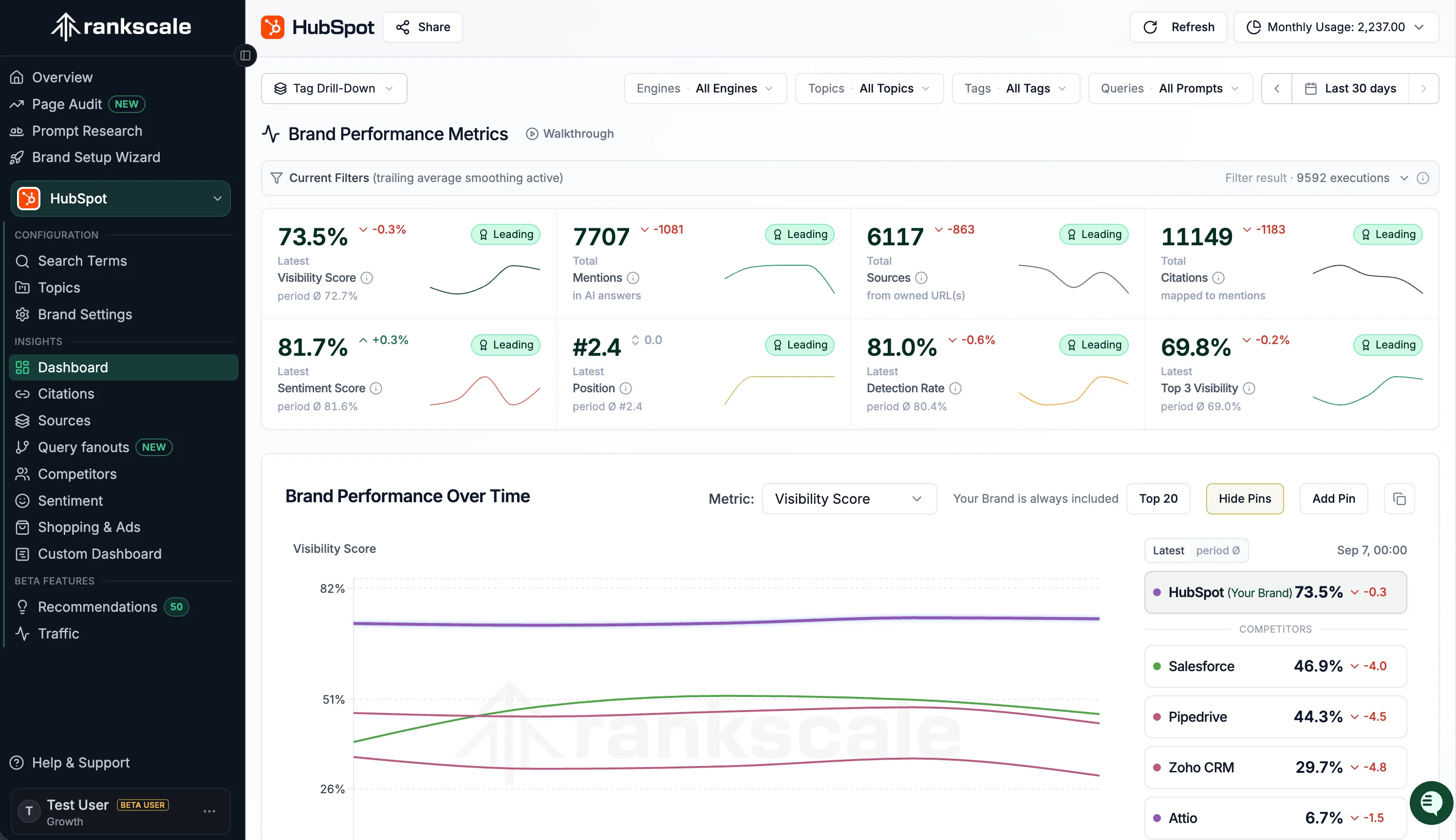
1. Visibility tracker and brand dashboard
Track visibility score, rankings and sentiment across engines, slice data by engine and timeframe, and connect GA4 and Search Console (beta) to link visibility to traffic. [1] [3]
2. Competitor analysis
Competitors are auto-identified in AI answers, with visibility, citation and sentiment comparisons and ranking gaps. [1]
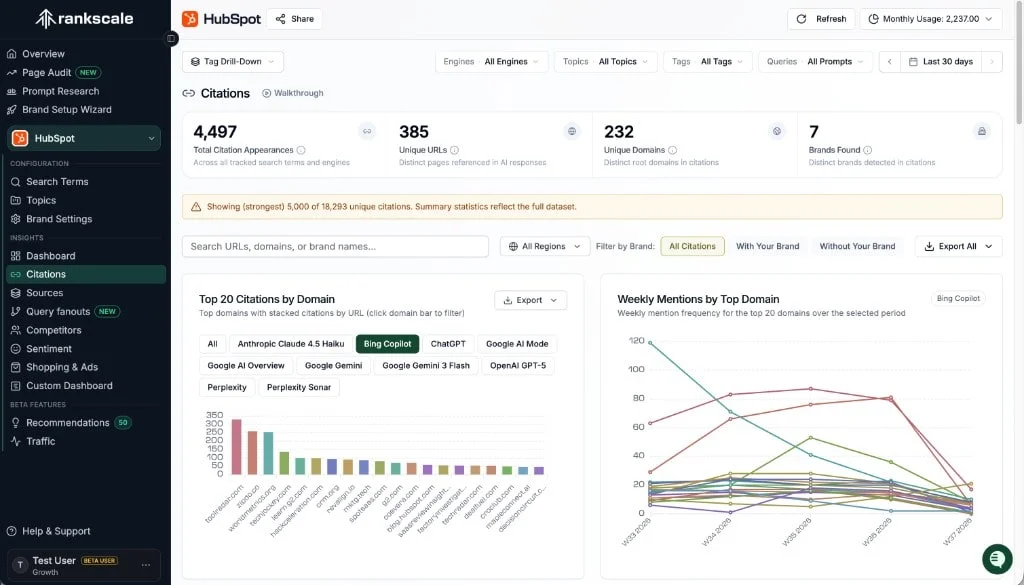
3. Citations and Sources
Citation analysis shows where AI engines cite your brand and how often, per model; Sources analysis inspects domains and URLs in AI source boxes with coverage, rank and share of voice by engine. [1] [4]
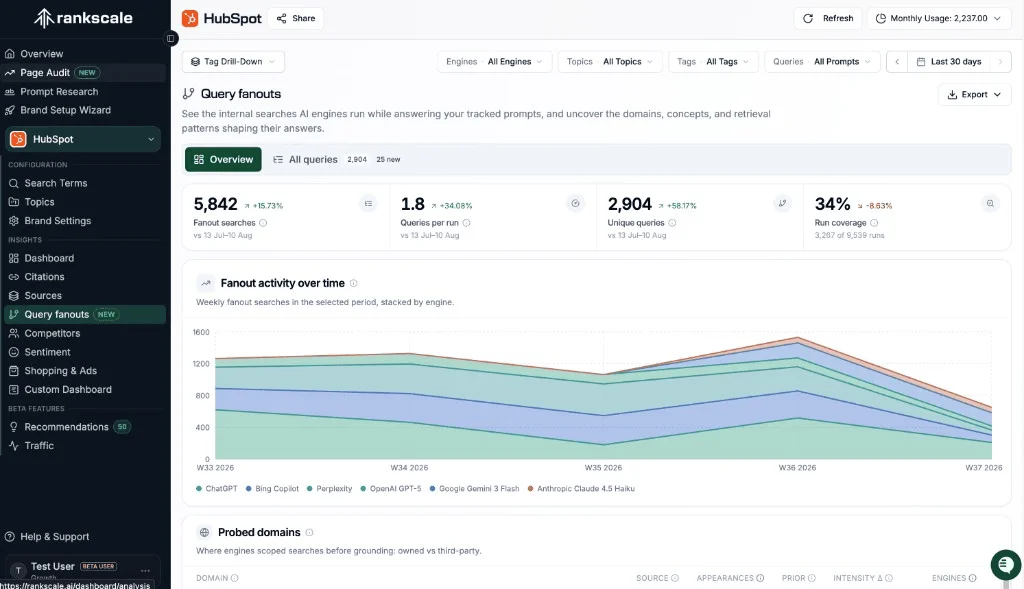
4. Query fanouts
See the internal searches AI engines run before answering, the domains they probe and which engines fan out most on your prompts. [5] Practical value: fanout queries are a concrete keyword list for content that gets retrieved.
5. Sentiment
Sentiment by brand, topic and model, with positive and negative keyword themes and perception trends. [1]
6. Shopping & Ads
Shopping items and sponsored placements in AI answers, merchant reach and buybox wins across ChatGPT, Google AI Mode and Copilot. [1] [9] Rare among competitors and valuable for e-commerce.
7. ChatGPT follow-up forms and local results
Rankscale captures the criteria forms ChatGPT shows before answering (budget, use case) and location-specific answers with map pins. [8] [2]
8. AI Visits and page audits
AI Visits shows which AI crawlers and agents read your site, which pages they open and whether they read your llms.txt. [7] Page audits score AI readiness, crawlability and technical signals with prioritized fixes (50–200 audits included per month). [6] [2]
9. Prompt research and Rankscale Scout
Prompt research estimates prompt volume through semantic reconstruction—Rankscale's own method, so treat volumes as modeled. [10] Rankscale Scout gives recommendations on what to change to appear in more answers (beta). [2] Pair it with our prompt-selection framework.
How to read Rankscale's metrics without overstating the result
| Signal | What it helps answer | Do not infer |
|---|---|---|
| Visibility Score | How visible you are across tracked answers. | A score comparable across different prompt or engine sets. |
| Detection rate | Share of runs where your brand is detected. | That the mention recommends you. |
| Position / Top 3 visibility | How high you appear in answers. | Click-through or traffic. |
| Citations / Sources | Which domains and URLs shape answers. | That one placement guarantees mentions. |
| Sentiment Score | How positively you are framed. | Customer satisfaction. |
| Fanout coverage | How often engines search before answering. | That every fanout query is worth targeting. |
Our reporting rule: never mix app and API engines in one headline number without labeling it, keep a stable prompt set for four weeks and validate with your own analytics. See LLM citation analytics explained.
Rankscale pricing in November 2026
All plans include 17+ engines, all regions and languages, unlimited prompts, MCP, sentiment and shared dashboards. Yearly billing saves 15%. [2]
| Plan | Monthly | Yearly (per month) | Credits / max app answers | Adds |
|---|---|---|---|---|
| Pro | $99 | $84.15 | 1,200 / 4,800 | 10 brand dashboards, 50 page audits, 7-day trial |
| Pro+ | $229 | $194.65 | 3,000 / 12,000 | REST API, 5 prompt researches, 25 dashboards, 100 audits |
| Growth | $385 | $327.25 | 5,500 / 22,000 | White-label links & dashboards, success manager, 50 dashboards, 200 audits |
| Enterprise | $780 | $663 | 12,000 / 48,000 | Team training, 20 prompt researches, 100 dashboards |
| Custom | On request | On request | Tailored | SSO, custom API, SLA, individual credits |
Extra brand dashboards cost $9/month each; credits, prompt research and audits can be topped up anytime. Unused credits roll over up to 2× (Pro, Pro+) or 3× (Growth, Enterprise). [2]
What credits mean in practice
| Engine type | Credits per answer | Examples |
|---|---|---|
| App (GUI) | 0.25 | ChatGPT, Google AI Mode, AI Overviews, Gemini, Bing AI Mode |
| API | 1–4 | GPT-5 (1), Claude Sonnet 5.5 (3), Gemini 3.1 Pro (4), Meta Muse Spark (4) |
| API + web search | 3–4 | GPT-5 (4), Claude Sonnet 5.5 (4), Gemini 3.8 Flash (4) |
Our illustrative math: 50 prompts run daily on four app engines = 50 × 4 × 0.25 × 30 ≈ 1,500 credits—slightly above Pro. Run the same prompts weekly and it drops to ≈ 215. Add Claude Sonnet 5.5 daily for those 50 prompts and Claude alone uses ≈ 4,500 credits, which points to Growth. Use the official credit calculator before choosing a plan. [2]
Black Friday note: at the time of writing Rankscale advertises 50% off the first two months on every plan with code RANKNOV26 until November 30, 2026, 23:59 CET. [1] Check current terms.
Start Rankscale 7-day trialPros and limitations: our editorial assessment
Reasons to shortlist
- 17+ engines incl. Claude, DeepSeek, Mistral, Meta.
- All countries and languages on every plan.
- Unlimited prompts; credits roll over.
- Query fanouts and probed domains.
- Shopping & ads visibility.
- AI bot visits and page audits included.
- Strong agency features from Growth.
Reasons to hesitate
- Variable credit burn complicates budgeting.
- API models cost 4–16× app answers.
- REST API only from Pro+.
- White-label only from Growth.
- Several features still in beta.
- Prompt volumes are modeled estimates.
A practical 30-day Rankscale evaluation plan
Illustrative workflow—not an AIToolRush case study. Imagine a CRM vendor starting on the Pro trial.
Week 1: set up and budget
Add 40–50 buyer prompts in topics and tags. Start with the five app engines daily and one API model weekly; check burn in the monthly usage meter.
Week 2: benchmark
Record visibility, detection rate, position and sentiment per engine against three auto-detected competitors.
Week 3: follow sources and fanouts
Export top cited domains and fanout queries for prompts where you are missing; run page audits on your five most important pages.
Week 4: connect to outcomes
Check AI Visits and GA4 traffic, review Scout recommendations, and decide on cadence, engines and plan size.
Next steps: our AI search visibility playbook.
Rankscale vs. AthenaHQ, Peec AI, Otterly.AI and Profound
Rankscale vs. AthenaHQ
Both are credit-based with broad engine coverage. Rankscale has more engines and more agency dashboards per dollar; AthenaHQ has a free tier. AthenaHQ review.
Rankscale vs. Peec AI and Otterly.AI
Peec AI and Otterly.AI use prompt-based plans with model limits or add-ons; Rankscale includes every engine but meters by credits. Peec AI review · Otterly.AI review.
Rankscale vs. Surfer and Ahrefs Brand Radar
Surfer is simpler with fixed prompt counts and a content workflow; Brand Radar offers a huge pre-built index. Surfer review · Brand Radar review.
Rankscale vs. Profound
Profound is a custom-priced enterprise platform; Rankscale delivers broad coverage at transparent prices. Profound review.
See the full shortlist in our AI search visibility tools comparison.
Questions to answer before buying Rankscale
- Engines: Which app and API engines matter to our buyers?
- Cadence: Which prompts need daily vs. weekly runs?
- Credits: What does the calculator recommend for our setup?
- Markets: How many countries and languages?
- Brands: How many brand dashboards?
- Integrations: MCP enough, or REST API (Pro+)?
- Clients: Do we need white-label (Growth)?
- E-commerce: Do shopping results matter?
Decision rule: choose Rankscale if breadth across engines and markets is the priority and you are comfortable managing credits.
Rankscale review: frequently asked questions
Sources, evidence and editorial methodology
This review was researched against Rankscale's official homepage, pricing page and feature pages on November 21, 2026. Images are official Rankscale product visuals with example brands; they do not show our account or measured results.
We did not access a paid account or audit accuracy, support or business impact.
- Rankscale homepage
17+ engines, feature overview (visibility, competitors, citations, sources, sentiment, shopping & ads, query fanouts, page audits, prompt research), GA4/Search Console beta; official product visuals.
- Rankscale pricing
Pro, Pro+, Growth, Enterprise; credits, credit cost per engine, rollover, brand dashboards, page audits, prompt research, trial, feature comparison table, credit calculator.
- AI rank tracker
Visibility performance tracking across engines.
- AI citation tracking
Cited sources and how often yours appear.
- Query fanout
Background searches AI engines run to build answers; probed domains.
- Page audit
AI readiness checks for any URL.
- AI Visits
AI crawlers and agents on your site, pages opened, llms.txt reads.
- ChatGPT follow-up forms
The criteria form ChatGPT shows before answering.
- Shopping analysis
Product and shopping results inside AI answers.
- Prompt research
Prompt suggestions and estimated volume via semantic reconstruction.
See our review methodology and affiliate disclosure. Found a change? Send a correction.
The bottom line: maximum coverage, metered by credits
Rankscale stands out for including every engine, market and language on every plan, plus an unusually deep feature set for the price.
Our recommendation: use the 7-day Pro trial with app engines first, measure your real credit burn, then add API models where they matter.